Shiji Photonics H1 2026: AI Data Center Boom Drives 77% Chip Revenue Surge — But Cash Flow Tells a Different Story
By Jergeo Engineering Team | August 2, 2026 · Based on Shiji Photonics 2026 Semi-Annual Report

Summary
Shiji Photonics (688313.SH) delivered a headline-grabbing first half of 2026 — revenue up 50.66% to RMB 1.495 billion, optical chip and device revenue surging 77.64% to RMB 1.243 billion, driven by AI data center demand for AWG chips and fiber connectors. But beneath the surface, operating cash flow collapsed to -RMB 380 million, accounts receivable swelled 68%, inventory piled up 71%, and the company is leaning on short-term borrowings to fund working capital. For the ODN industry, this report confirms the demand boom is real — but also that even IDM-scale players are trading debt for volume. Smaller ODN manufacturers can differentiate on agility, short payment terms, and low MOQs while the big players are stretched thin.
The Revenue Surge: AI Data Centers Drive 77% Optical Chip Growth
Henan Shijia Photonic Technology Co., Ltd. (688313.SH), a leading IDM (integrated device manufacturer) on the Shanghai STAR Market, released its 2026 semi-annual report on July 31. The top-line numbers are unambiguous: revenue of RMB 1.495 billion, up 50.66% year-over-year; net profit attributable to shareholders of RMB 315 million, up 45.30%; and 扣非 net profit of RMB 309 million, up 44.42%. Basic EPS came in at RMB 0.6964, and the weighted average ROE reached 18.51%, up from 16.56% in the prior-year period, as reported by The Paper (澎湃新闻) and Sina Finance.
The engine behind this growth is the optical chip and device segment, which generated RMB 1.243 billion — 83.15% of total main business revenue — and grew 77.64% year-over-year. Within this segment:
- Fiber connectors: RMB 762 million — the single largest product line, driven by MT-FA and FAU demand from data center interconnects
- AWG products: RMB 383 million — arrayed waveguide gratings scaling rapidly with 800G/1.6T transceiver production
- DFB products: RMB 48.9 million — distributed feedback laser chips for telecom and datacom
- PLC products: RMB 25.44 million — planar lightwave circuit splitters, the workhorse of ODN passive infrastructure
- Other optical devices: RMB 24.31 million
These products — PLC splitters, AWG chips, fiber arrays, and fiber connectors — are the foundational passive components of any Optical Distribution Network. When an ODN manufacturer looks at these numbers, the message is clear: AI data center construction is pulling through ODN component demand at a pace not seen since the FTTH rollout wave of the early 2010s.
Overseas demand is accelerating even faster. Revenue from outside China reached RMB 881 million, up 95% year-over-year, now representing 58.89% of total revenue. The Thai subsidiary contributed RMB 23.71 million in net profit, suggesting the company's Southeast Asian manufacturing base is beginning to pay off.
The Cash Flow Warning: -RMB 380M Operating Cash Flow
Here is where the narrative shifts. Operating cash flow came in at -RMB 380 million, a dramatic reversal from +RMB 11 million in the same period last year. That is a RMB 391 million year-over-year deterioration. For a company reporting RMB 315 million in net profit, this gap between earnings and cash generation demands attention.
The culprits are familiar to anyone who has watched a high-growth manufacturer push for volume:
- Accounts receivable: RMB 869 million, up 68.18% from year-end 2025 — customers are taking longer to pay, or the company is extending terms to win orders
- Inventory: RMB 859 million, up 71.13% from year-end — raw materials, work-in-progress, and finished goods are accumulating faster than shipments
- Gross margin: 36.18%, down 1.20 percentage points year-over-year — pricing pressure or product mix shift is eroding profitability per unit
To bridge the cash gap, Shiji Photonics is turning to debt. Short-term borrowings rose 80.24% to RMB 591 million, and long-term borrowings increased approximately 9x from RMB 11 million to RMB 110 million. Meanwhile, cash on hand fell 27.36% from RMB 357 million to RMB 259 million. The company is, in effect, borrowing to fund its customers' purchases and its own inventory buildup — a classic pattern in capacity arms races, as noted by Star Market Daily (科创板日报).
What This Means for the ODN Industry
Shiji Photonics sits at the intersection of two trends that matter directly to ODN equipment manufacturers and system integrators:
First, the AI-driven demand pulse is real. AWG chips (used in WDM multiplexers for 800G/1.6T transceivers), fiber arrays (MT-FA, FAU — the interface between chip and fiber), and fiber connectors are all shipping at volumes that validate the data center buildout thesis. When optical chip revenue grows 77.64% at an IDM with in-house wafer fabrication, this is not speculative — these are components that have already been designed in, qualified, and are shipping in production quantities.
Second, the growth is coming with deteriorating economics. Gross margin compression, negative cash flow, and rising leverage suggest that the industry is in a phase where volume is being prioritized over unit economics. This is not unique to Shiji Photonics — it is the natural dynamic of an industry in a capacity arms race. The company's planned RMB 2.8 billion private placement (targeting high-speed AWG chip capacity, CW laser器 chip development, and MPO/MMC connector expansion) is a bet that today's margin sacrifice will be repaid by tomorrow's scale advantages.
For the broader ODN industry, this creates a dual signal:
- Upstream chip supply will remain tight in the near term — Shiji Photonics is building capacity, but the lead times for AWG, PLC, and connector components will stay high until new production lines come online in 2027–2028
- Pricing pressure will intensify — when a listed IDM with RMB 14.95 billion in revenue is accepting thinner margins to maintain volume, smaller ODN assemblers face margin pressure on the passive components they source
- Lead times and payment terms are becoming competitive weapons — the 68% jump in accounts receivable means someone is offering extended payment terms to win orders, forcing competitors to match or lose share
The Small Manufacturer Playbook: Agility as Differentiation
When the largest players in your supply chain are stretching their balance sheets to capture volume, smaller manufacturers have a structural opening. Here is what the Shiji Photonics data suggests as a competitive response for ODN equipment makers:
Short payment terms are a feature, not a bug. When your upstream supplier is sitting on RMB 869 million in receivables and negative cash flow, a customer who pays in 30 days instead of 90 is a lifeline. Smaller manufacturers that insist on shorter payment cycles can negotiate better pricing and priority allocation — and they should, because the alternative is waiting in line behind customers who are already consuming Shiji Photonics' limited production capacity on extended terms.
Low MOQ and fast turnaround win in a supply-constrained market. When AWG chip lead times stretch to 16–20 weeks at an IDM running flat-out, a smaller ODN manufacturer who can assemble and ship a fiber distribution frame or patch panel in 4–6 weeks from a buffer stock of standard components is solving a real problem for the project manager on a data center buildout schedule.
Margin discipline matters more in a downturn. The risk in the current cycle is that demand decelerates before the capacity additions come online. If AI capex spending slows in 2027–2028 — whether from AI commercialization disappointment, interest rate pressure, or policy shifts — the industry will face overcapacity at the chip level while ODN equipment demand drops. Smaller manufacturers who maintained margins during the boom will have the balance sheet strength to survive the correction; those who matched the margin sacrifice will not.
The R&D Paradox: Spending Less While the Market Accelerates
One of the more concerning data points in this report is the decline in R&D spending. R&D expense fell 3.24% to RMB 59.42 million, and R&D intensity (R&D as a percentage of revenue) dropped from 6.19% to 3.97%. This is happening in a market where 800G is scaling to commercial volumes, 1.6T is entering early deployment, and the product roadmap demands continuous innovation in AWG channel count, connector density, and laser器 chip performance.
For an IDM that controls its own fab, reduced R&D spending could mean one of two things: either the current product portfolio is sufficient for near-term demand (a reasonable position if 800G AWG and fiber connectors are selling as fast as they can be made), or the company is prioritizing current production over advanced product development. If the latter, it creates a window for competitors — including smaller ODN manufacturers working with fabless chip designers — to capture share in advanced product categories like co-packaged optics (CPO) connectors and multi-fiber push-on (MPO) arrays for 1.6T.
Industry Context: The Capacity Arms Race
Shiji Photonics is not an outlier in its financial profile — it is a leading indicator. Across the optical component supply chain, companies are making similar trade-offs:
- Corning is investing 10x in US optical fiber capacity with NVIDIA, funded by multi-billion-dollar supply agreements
- YOFC projects 10–20x growth in polarization-maintaining fiber, with major capex for AI data center preform capacity
- Far East Fiber raised RMB 2 billion for AI data center preform rod manufacturing, scaling from 300 to 2,100 tons/year
The common pattern: revenue is growing fast, but cash generation is lagging, and debt is rising. The industry is in what might be called the "install base accumulation" phase — building capacity today that will generate returns over a 3–5 year depreciation cycle. The bet is that AI compute demand will continue to accelerate; the risk is that it will not, or that technology shifts (silicon photonics integration, co-packaged optics) will render some of this capacity obsolete before it is fully depreciated.
For ODN equipment manufacturers who sit between the chip suppliers and the data center operators, the strategic question is clear: how do you ride the demand wave without getting caught in the margin and leverage undertow? The answer likely involves maintaining a diversified customer base (telecom + data center), insisting on payment discipline, and building flexible manufacturing that can pivot between product categories as demand signals shift.
ODN Equipment for AI Data Center Buildouts
As optical chip demand surges and supply chains stretch, reliable ODN passive infrastructure becomes a project-critical path item. Jergeo's data center ODN products are designed for fast deployment with standard configurations available from stock:
For main distribution area cross-connects, Jergeo Optical Distribution Frames deliver high-density fiber management up to 1,440 ports per frame, with modular configurations that scale from initial deployment through phased expansion — matching the multi-stage buildout model used by hyperscale operators.
For campus-level outdoor fiber interconnection between data center buildings, Jergeo Fiber Distribution Cabinets are engineered in SMC and stainless steel with IP65 protection, available from 72 to 1,152 ports with drawer-type tray designs for efficient splicing.
For rack-level patching in AI compute clusters, Jergeo Fiber Patch Panels support high-density LC and MPO/MTP configurations in standard 19" rack-mount form factors — designed for the dense interconnect requirements of GPU clusters where port counts reach 96–192 per rack.
Explore Data Center SolutionsRelated Products
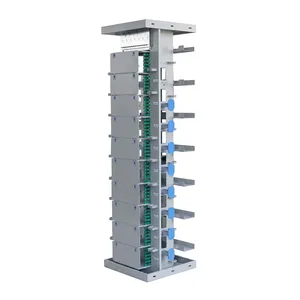
JODF-A1 Optical Distribution Frame
720 ports ODF with 42U capacity for main cross-connects in data centers
View Product →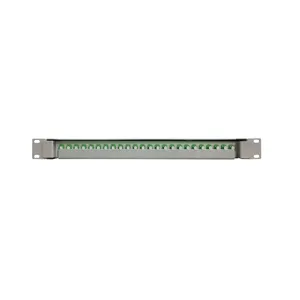
JODF-U3A Optical Patch Panel
24–96 ports sliding type patch panel for AI data center rack patching
View Product →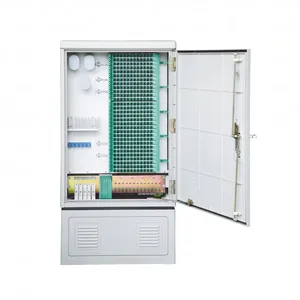
JFDC-288A Fiber Distribution Cabinet
288 ports FDC with IP65 SMC enclosure for data center campus distribution
View Product →Related Articles

Aofei Data H1 2026 Earnings: AI Data Center Expansion Reshaping Fiber and ODN Demand
Read Article →
Corning Q2 2026 Earnings: AI Data Centers Drive Record Fiber Optic Demand
Read Article →
Meta's $279B Data Center Lease — What Big Tech's Infrastructure Lockdown Means for Fiber and ODN
Read Article →Sources
This article is based on Shiji Photonics' 2026 Semi-Annual Report (688313.SH) filed with the Shanghai Stock Exchange on July 31, 2026, as reported by The Paper (澎湃新闻), Sina Finance, and Star Market Daily (科创板日报). Industry context derived from previously reported earnings and expansion plans for Corning, YOFC, and Far East Fiber. All figures reflect publicly available data as of August 2, 2026.