China Fiber Optic Cable Demand Surges 75.9% — AI Data Centers, Drones and Global Infrastructure Fuel Unprecedented Growth
By Jergeo Engineering Team | August 2026 · 10 min read · Based on CRU Group, China Customs, and industry reporting

Summary
Global data center fiber optic cable demand grew 75.9% in 2025 to 69.6 million fiber-kilometers, and is projected to reach 91.6 million fiber-kilometers in 2026 (CRU Group). A single 10,000-GPU AI computing center consumes 5–10x more fiber than a traditional data center. China's fiber exports surged 200% in early 2026 by value, with March alone hitting $245 million. Three forces — AI data centers, fiber optic drones (est. 120M fiber-km in 2026), and overseas infrastructure expansion — are converging to create the tightest fiber market in two decades. For ODN equipment suppliers, the signal is clear: every fiber deployed requires cabinets, patch panels, and distribution frames.
The Numbers: 75.9% Growth and Accelerating
According to CRU Group's optical cable market report, global data center fiber optic cable demand surged 75.9% year-over-year in 2025, reaching 69.6 million fiber-kilometers. For 2026, CRU projects demand will climb to 91.6 million fiber-kilometers — a further 31.6% increase that would make data centers the single largest consumption category in the global fiber market.
The context matters. In 2023, data center fiber demand accounted for less than 15% of total global consumption. By 2026, it will approach 30%. The shift reflects a fundamental change in what drives fiber consumption: instead of connecting homes (FTTH), the primary growth engine is now connecting GPUs inside AI data centers.
A single 10,000-GPU AI computing center requires 5 to 10 times more fiber optic cable than a traditional data center of equivalent floor space. This is because every GPU server rack needs high-bandwidth fiber interconnects — both east-west traffic between racks for distributed training workloads and north-south traffic to the switching fabric. A typical 10,000-GPU cluster uses 400G or 800G optical transceivers on every server port, with MPO trunk cables running between every pair of adjacent racks.
Three Forces Converging on Fiber Supply
Driver 1: AI Data Centers Under Construction Globally
Every hyperscaler — Microsoft, Google, Amazon, Meta, ByteDance — is scaling AI infrastructure. The Stargate project in the US alone targets $500 billion in cumulative investment. Across China, dozens of 10,000-GPU clusters are under construction simultaneously. Each one consumes millions of meters of fiber optic cable before a single training job runs.
The math is stark. If each 10,000-GPU cluster requires roughly 2,000–4,000 fiber-km of intra-datacenter cabling (depending on topology), and the industry is deploying hundreds of such clusters in 2026, the incremental demand easily reaches tens of millions of fiber-kilometers annually.
Driver 2: Fiber Optic Drones
A newer demand source has emerged: fiber optic guided drones (fiber optic UAVs). Unlike radio-frequency drones, fiber optic guided drones use a thin fiber optic cable spooled from the ground station as the control and data link — making them immune to electronic warfare jamming.
Each drone mission consumes 20 to 50 kilometers of specialty single-mode fiber. With military and commercial programs ramping globally, 2026 fiber demand from drones alone is estimated at 120 million fiber-kilometers — a number that would represent roughly one-third of total global fiber demand at 2024 levels. This application is entirely new and was not part of any demand forecast even 18 months ago.
Driver 3: Overseas Infrastructure Expansion
Governments worldwide continue to accelerate FTTH and 5G backhaul deployments. The US BEAD program, the EU's Gigabit Infrastructure Act, and broadband programs across Southeast Asia, Africa, and Latin America are adding tens of millions of fiber-kilometers of annual demand. While individual country programs are well-documented, their combined effect —叠加 AI data center demand — creates a supply picture that no one anticipated even two years ago.
Export Data Confirms the Surge
China's customs data provides real-time confirmation of the demand surge. Between January and April 2026:
- Fiber optic cable export value grew 200.05% year-over-year
- March 2026 alone saw $245 million in fiber exports — a 263.84% year-over-year increase
- Export volumes rose 30.46% year-over-year
- Export average prices climbed 204.32% year-over-year
The price-volume split is telling. A 30% volume increase combined with a 204% price increase means the market is not just buying more fiber — it is paying dramatically more per unit. This is classic shortage pricing: demand has outpaced supply, and buyers are competing for limited available tons.
China accounts for 56.3% of global fiber optic cable shipments, reaching 372 million fiber-kilometers in total output in 2025. When Chinese export prices rise 200%, the rest of the global market follows — because there is no alternative supply source at comparable scale.
The FTTG Shift: From Homes to GPUs
YOFC (Yangtze Optical Fibre and Cable, 长飞光纤), the world\'s largest fiber manufacturer, has formalized this shift with a new term: FTTG — Fiber to the GPU.
At WAIC 2026, YOFC\'s president stated: "The AI wave is driving fiber optic cable demand to extend deeply from FTTH toward FTTG." The statement signals that the industry's demand model — built around FTTH subscriber counts and household penetration rates — is being replaced by a GPU-count model.
The practical difference is significant. FTTH uses standard G.657.A1/A2 bend-insensitive fiber with relatively modest bandwidth requirements per connection point. FTTG applications demand higher fiber counts per connection, MPO/MTP multi-fiber connectors, and increasingly specialty fibers like polarization-maintaining fiber for coherent interconnects. China Telecom's 2025–2026 backbone fiber procurement illustrates the trend: YOFC won approximately 2.24 million fiber-kilometers of G.654.E ultra-low-loss fiber — a specification designed for long-haul and data center interconnect, not residential access.
ODN Perspective: Density Bottlenecks and High-Density Distribution
For ODN (Optical Distribution Network) passive component suppliers, the demand surge creates specific engineering challenges.
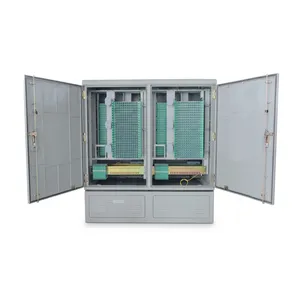
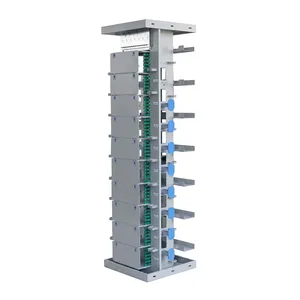
The density bottleneck. When a 10,000-GPU data center needs to manage thousands of fiber connections per equipment rack — which is a realistic number for high-density GPU cluster interconnect — the physical space available for patch panels and distribution frames becomes the limiting factor. Traditional 288-port fiber distribution cabinets, designed for FTTH distribution points, are insufficient for AIDC applications where 576-port or 1,152-port configurations are becoming the baseline for main distribution areas.
FTTG demands different ODN. The shift from FTTH to FTTG means ODN infrastructure must accommodate different cable diameters, tighter bend radius requirements, and connector types. Standard splice trays designed for G.652D fiber may not fit specialty fibers used in AI interconnects. MPO-based patch panels are replacing LC-based panels in AI data center main distribution areas because a single MPO connector carries 12, 16, or 24 fibers in one ferrule — essential when every rack needs thousands of connections.
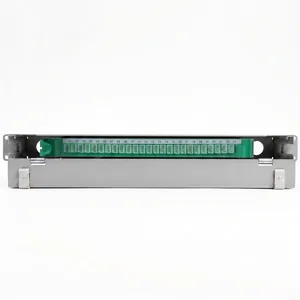
High-density patching is now baseline. A 1U patch panel with MPO connectors can deliver up to 144 fibers in a single rack unit. For AI data center deployments, this density is the minimum specification. Traditional patch panels offering 24–48 LC ports per 1U are being phased out in new AI data center builds.
What Procurement Teams Should Consider
The demand data from CRU, China Customs, and manufacturer statements points to a sustained period of high fiber consumption. Three practical considerations for ODN procurement:
Plan for density headroom. If your current FDC specification is 288 ports, evaluate whether 576-port or 1,152-port configurations would provide adequate expansion capacity for AI-related fiber growth. The cost differential between cabinets is modest compared to the cost of replacing undersized infrastructure in the field.
Specify MPO-ready ODF and patch panels. As AI workloads drive fiber counts per rack into the thousands, MPO-based connectivity becomes essential. Ensure your ODF and patch panel specifications support MPO trunk cables alongside traditional LC pigtails.
Lock in ODN supply before fiber allocation is finalized. History from the FTTH buildout shows that passive infrastructure procurement often lags fiber procurement by 3–6 months. With fiber demand at historic highs and lead times extending, ODN equipment that was previously a commodity item is now facing its own capacity constraints. Secure cabinet and distribution frame supply in parallel with fiber procurement — not after.
Sources
This article is based on CRU Group 2025–2026 optical cable market reports. China fiber export data sourced from China Customs official statistics (January–April 2026). YOFC FTTG concept from WAIC 2026 official proceedings. China Telecom backbone fiber procurement data from YOFC official bid announcements. Fiber optic drone demand estimates from industry reporting on single-use fiber guided UAV programs. Data center fiber consumption multipliers from field deployment data across hyperscaler AI clusters.