Aofei Data H1 2026 Earnings Surge: How AI Data Center Expansion Is Reshaping Fiber Optic and ODN Demand
By Jergeo Engineering Team | August 1, 2026 · Based on Aofei Data 2026 Semi-Annual Report
Summary
Aofei Data's first-half 2026 results — revenue up 27.95% to RMB 1.47 billion, net profit more than doubling to RMB 197 million, and EBITDA up 50% — are the clearest financial signal yet that China's AI smart computing center buildout is moving from capex cycle to operating leverage. With 86,000+ cabinets in operation and multiple projects under construction across five key regions, the company's trajectory mirrors a broader industry pattern: every new megawatt of AI data center capacity requires a proportional expansion of passive fiber infrastructure. For ODN equipment — fiber distribution cabinets, optical distribution frames, patch panels, and splice closures — this means a multi-year demand cycle where fiber content per rack continues to rise as AI cluster architectures push deeper into all-optical interconnects.
Guangdong Aofei Data Technology Co., Ltd. (300738.SZ), one of southern China's leading third-party data center operators, released its 2026 semi-annual report on July 31. The headline numbers are large: revenue of RMB 1.469 billion (up 27.95% year-over-year), net profit attributable to shareholders of RMB 197 million (up 123.64%), and EBITDA of RMB 891 million (up 50.00%). Operating cash flow nearly doubled to RMB 852 million, up 88.90% from the same period last year, as reported by Shanghai Securities News and verified across multiple financial data providers (Sina Finance, Aug 1 2026) (S&P Capital IQ via MarketScreener, Jul 31 2026).
More important than the headline numbers is what's driving them. The company explicitly attributes the profit acceleration to rising utilization rates at its AI-optimized smart computing centers. As rack fill rates improve, the fixed cost base — depreciation, amortization, and financing charges — gets spread across a larger revenue base, producing the kind of operating leverage that the IDC business model promises but only delivers when supply and demand align. Aofei Data's gross margin on core IDC services reached 33.82%, up 0.33 percentage points year-over-year, even as the business scaled.
The Scale of Aofei Data's Infrastructure Footprint
As of June 30, 2026, Aofei Data operated more than 86,000 standard cabinet equivalents across 16 self-built data centers, with a total operating capacity of approximately 382MW. During the first half of the year, the company brought online the eighth building at its Langfang Guan data center campus and completed the first phase of its Wuxi data center — its first self-built facility in the Yangtze River Delta region. The Hebei Huailai data center, located in the Zhangjiakou cluster of the Beijing-Tianjin-Hebei national computing hub, has completed its civil engineering phase and is on track to deliver 15,000 cabinets (Shanghai Securities News, Aug 1 2026).
Geographically, Aofei Data's footprint spans the major computing corridors in China. North China remains the revenue engine at RMB 1.024 billion (70% of IDC revenue, up 34.52% YoY), but the fastest growth is coming from newer markets — the "other regions" category, driven by the Wuxi expansion, grew 88.85% year-over-year. This geographic diversification pattern is replicated across the broader Chinese IDC industry: operators are moving beyond the traditional Beijing-Shanghai-Guangzhou triangle to establish capacity in designated national computing hub locations.
Why This Matters for the Fiber Optic Supply Chain
The connection between Aofei Data's earnings and the fiber optic industry is direct and mechanical. Every data center buildout follows a predictable construction sequence, and fiber infrastructure goes in early. Civil works and electrical infrastructure are laid first. Then the structured cabling, backbone fiber, cross-connect systems, and rack-level patching are installed — all before a single server rack is rolled in. ODN passive equipment is front-loaded in the construction timeline, which means the demand signal for fiber distribution cabinets, ODFs, and patch panels leads the eventual revenue recognition by the data center operator.
At Aofei Data's current scale — 382MW in operation and significant capacity under construction — the fiber infrastructure requirements are substantial. A typical 10MW data center building requires thousands of fiber terminations across multiple distribution layers: campus backbone interconnections, building entrance facilities, main distribution areas (MDAs), intermediate distribution areas (IDAs), and rack-level patching. Each of these layers depends on passive ODN hardware. As Aofei Data adds capacity from 382MW toward its multi-year target of 500MW+, the fiber infrastructure buildout proceeds in lockstep with each construction phase.
AI Racks Multiply Fiber Port Requirements
The shift from general-purpose colocation to AI-optimized smart computing centers is not just a marketing rebrand — it changes the physical infrastructure equation in a fundamental way, and fiber is one of the most affected categories. Traditional enterprise data center racks typically need 12 to 48 fiber ports. AI training clusters, with their high-bandwidth GPU-to-GPU interconnect requirements, push that range to 96 to 192 fiber ports per rack — a 4 to 8x increase. Each additional fiber port means more adapter plates, more patch panels, more splice trays, and more management hardware (WeDoAny Market Analysis, Jun 10 2026).
This port density multiplier is why the data center fiber optic market is growing far faster than the overall fiber market. According to CRU data, global data center fiber optic cable demand grew approximately 75.9% in 2025, vastly outpacing the ~4.1% growth in total global fiber demand. The trend is driven by hyperscaler AI buildouts in North America and, increasingly, by the smart computing center rollout in China. Aofei Data's own transition toward AI-optimized facility design — with projects like the Langfang Guan and Huailai campuses built to high-density AI specifications — is representative of this industry-wide shift.
China's Broader AI Data Center Construction Wave
Aofei Data is one operator among many, but its trajectory is consistent with the broader Chinese market. Installed data center capacity in China reached approximately 40GW in 2026, up from 32GW at the end of 2025, according to industry estimates (Blackridge Research, Jun 18 2026). The National Development and Reform Commission (NDRC) has outlined plans to invest approximately RMB 2 trillion (about USD 295 billion) between 2026 and 2030 to build a nationwide AI computing network connecting eight national computing hub nodes.
MarketsandMarkets projects the China AI data center market to grow from USD 42.18 billion in 2025 to USD 336.20 billion by 2032, representing a compound annual growth rate of 33.1%. Hyperscale data centers are expected to account for 66.2% of the market by 2032 as cloud providers and AI companies expand their dedicated facilities (MarketsandMarkets, Jul 2026). Cooling solutions are the fastest-growing segment at 33.5% CAGR, followed closely by network infrastructure as AI clusters drive demand for high-speed interconnects and passive optical components.
The "Eastern Data Western Computing" initiative, which redirects computing workloads from eastern coastal cities to western provinces with cheaper land and power, is also reshaping fiber infrastructure requirements. Long-haul backbone fiber links between hub nodes are being upgraded to 400G and 800G transmission systems, while data center clusters at each hub require expanded internal fiber distribution capacity. The resulting demand spans the full ODN product portfolio, from outdoor fiber distribution cabinets serving campus interconnections to high-density ODFs in meet-me rooms and rack-mount patch panels in AI compute halls.
ODN Passive Components: The Unsung Backbone of AI Infrastructure
The global optical distribution network (ODN) equipment market reached $51.3 billion in the first half of 2026, growing 21% year-over-year, according to Omdia's Q2 Global Fiber Infrastructure Report. While telecom access networks and 5G deployments remain important contributors, the fastest-growing segment is data center fiber infrastructure, driven by AI compute cluster deployment (Omdia via Fibermint, May 19 2026). For AI data center construction specifically, several ODN product categories are experiencing accelerated demand.
Fiber Distribution Cabinets: The Campus Distribution Layer
Large AI data center campuses with multiple buildings — like Aofei Data's Langfang Guan facility with eight buildings, or the ByteDance Datong AI campus spanning 205,000 square meters — require outdoor fiber distribution cabinets (FDCs) to manage inter-building fiber connections and serve as the demarcation point between campus backbone and building distribution networks. These cabinets, typically rated IP65 and built from SMC or stainless steel for outdoor durability, house fiber splice trays, splitters, and distribution modules. Jergeo's FDC product line spans 72 to 1,152 ports, supporting the full range of data center campus deployment scenarios.
Optical Distribution Frames: High-Density Cross-Connects
Inside the data center, main distribution areas and meet-me rooms rely on optical distribution frames (ODFs) to provide centralized cross-connect capability. High-density ODFs with 720 to 1,440 ports per 42U rack are standard in modern AI facilities, where the volume of fiber connections requires efficient use of floor space and clear cable management. The modular design of modern ODFs supports phased capacity expansion, matching the staged construction approach that data center operators like Aofei Data use to align capacity with demand.
Fiber Patch Panels: Rack-Level Patching for AI Clusters
At the rack and row level, fiber patch panels handle the high-density patching requirements of AI compute clusters. With 96 to 192 ports per AI rack, 1U and 2U patch panels with sliding drawer designs are essential for maintaining access and serviceability in dense cabling environments. MPO/MTP-based solutions for 400G and 800G interconnects further increase the port density per panel, as multiple fiber strands are terminated in a single connector. This trend directly benefits manufacturers of high-density patch panels and MPO-compatible fiber management hardware.
Jergeo ODN Solutions for AI Data Center Infrastructure
As AI data center construction accelerates across China and globally, the demand for reliable, high-quality passive ODN equipment continues to grow. Jergeo supplies a full range of fiber distribution products designed to support the full lifecycle of data center infrastructure — from initial campus buildout to phased capacity expansion and ongoing network maintenance.
For campus-level outdoor fiber distribution between data center buildings, Jergeo Fiber Distribution Cabinets are engineered in SMC and stainless steel with IP65 protection ratings, delivering the 20–25 year service life that data center operators require from their passive infrastructure. Available from 72 to 1,152 ports with drawer-type tray designs for efficient splicing and distribution.
For main cross-connect and meet-me room environments, Jergeo Optical Distribution Frames provide high-capacity fiber management supporting up to 1,440 ports per frame — with modular configurations that scale from initial deployment through phased capacity expansion, matching the multi-stage buildout model used by data center operators like Aofei Data.
For rack-level fiber management in AI compute clusters, Jergeo Fiber Patch Panels support high-density LC and MPO/MTP configurations in standard 19" rack-mount form factors — designed for the dense interconnect requirements of AI training architectures. Available in 12 to 144 port configurations with sliding tray designs for easy access and maintenance.
Explore Data Center SolutionsRelated Products
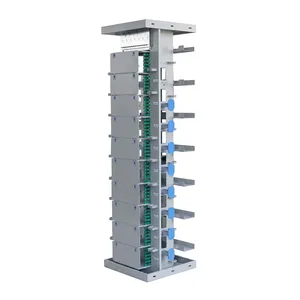
JODF-A1 Optical Distribution Frame
720 ports ODF with 42U capacity for main cross-connects in data centers
View Product →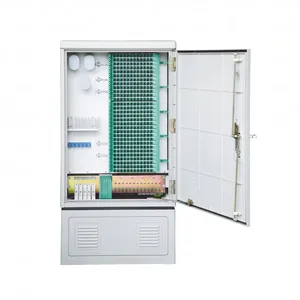
JFDC-288A Fiber Distribution Cabinet
288 ports FDC with IP65 SMC enclosure for data center campus distribution
View Product →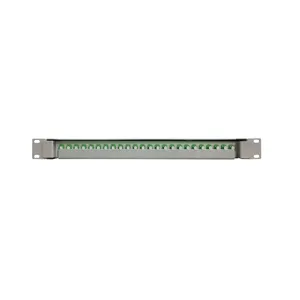
JODF-U3A Optical Patch Panel
24-96 ports sliding type patch panel for AI data center rack patching
View Product →Related Articles

Meta's $279 Billion Data Center Lease Bet — What Big Tech's Infrastructure Lockdown Means for Fiber Optics and ODN Equipment
Read Article →
Corning Q2 2026 Earnings: AI Data Centers Drive Record Fiber Optic Demand
Read Article →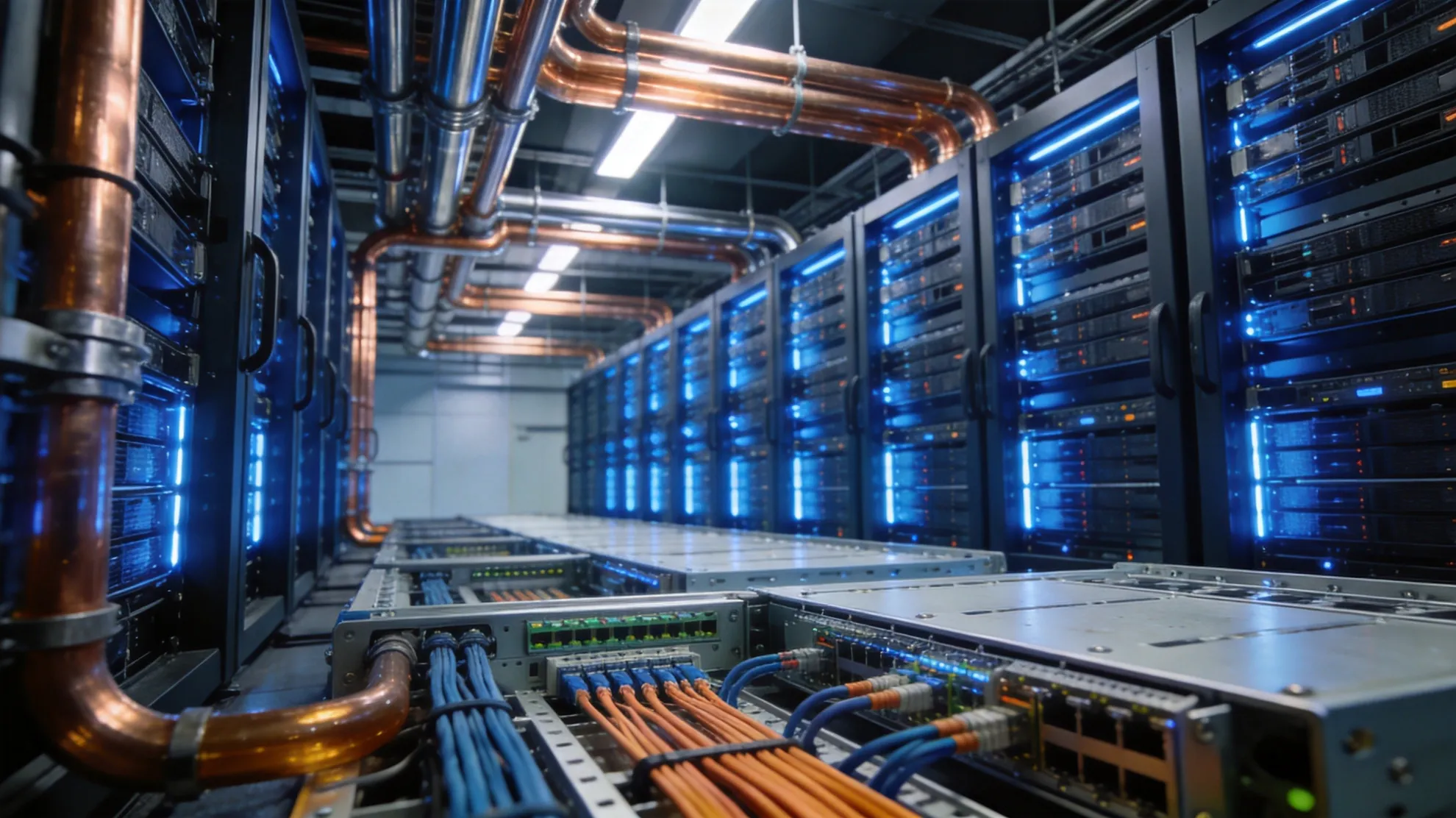
Liquid Cooling Industrialization: The Next Infrastructure Shift for AI Data Centers
Read Article →Sources
This article is based on Aofei Data's 2026 Semi-Annual Report filed with the Shenzhen Stock Exchange (July 31, 2026), as reported by Sina Finance, Shanghai Securities News, and S&P Capital IQ via MarketScreener. China AI data center market data from MarketsandMarkets (July 2026) and data center capacity figures from Blackridge Research (June 2026). ODN market data from Omdia Q2 Global Fiber Infrastructure Report, cited in Fibermint (May 2026). Fiber demand data from CRU Group, as analyzed in WeDoAny (June 2026). All figures reflect publicly available data as of August 1, 2026.