NVIDIA Invests $3 Billion in Lancium Power Infrastructure — What It Means for AI Data Center Fiber Demand
By Jergeo Engineering Team | August 9, 2026 · Based on reporting from The Information

Summary
NVIDIA is investing up to $3 billion in Lancium, a Texas-based power infrastructure developer, to secure access to grid capacity for the Stargate AI data center project. The deal — $2 billion upfront for roughly 20% equity, plus $1 billion more contingent on grid interconnection milestones — values Lancium at around $10 billion and marks a clear shift in the AI industry: power, not chips, has become the binding constraint on expansion. For the ODN passive fiber supply chain, the message is equally clear. GW-scale AI campuses require massive volumes of fiber distribution infrastructure, and with Stargate planning up to $500 billion in data center investment by 2029, the demand wave for ODFs, FDCs, and high-density patch panels is just getting started.
NVIDIA is putting $3 billion into a power company. The world's most valuable semiconductor firm, whose entire business model revolves around selling AI chips, is buying a large stake in Lancium — a Houston-based power infrastructure developer backed by Blackstone. The deal was first reported by The Information on August 8, 2026, and it tells you everything about where the AI industry's real bottleneck now sits.
Here is how the investment is structured. An initial $2 billion gives NVIDIA approximately 20% of Lancium's equity. An additional $1 billion follows if Lancium hits specific grid interconnection and development targets, which would push NVIDIA's ownership to roughly 30%. The deal values Lancium at around $10 billion. Blackstone, the private equity giant, remains the largest shareholder with about 50% of the company.
Lancium is led by CEO Michael McNamara and was founded around 2017-2018. The company specializes in building clean-energy data center campuses in Texas, where it has secured large amounts of grid interconnection capacity through ERCOT, the state's independent grid operator.
The Stargate Connection: $500 Billion in AI Data Centers
This is not just a financial investment. It is a land grab for power capacity, and the stakes are enormous. Lancium's Clean Campus in Abilene, Texas is the first confirmed physical location for the Stargate project — a joint AI infrastructure venture between SoftBank, OpenAI, and Oracle that aims to deploy up to $500 billion in AI data center capacity by 2029.
The Abilene site spans 1,000 acres and already has 1.2 GW of grid interconnection approved by ERCOT. To put that in perspective, a typical hyperscale data center might run at 30-50 MW. Lancium's Clean Campus is operating at 24-40 times that scale on a single property. The campus is designed to hold approximately 400,000 NVIDIA AI chips across eight buildings, with each building supporting 50,000 GB200 NVL72 systems.
Lancium is also developing a second GW-scale campus in Childress, Texas, suggesting the company is building a portfolio of pre-approved power sites that it can offer to AI infrastructure players like Stargate. The company is reportedly considering an IPO as early as 2027.
Why Power, Not Chips, Is Now the Bottleneck
For the past several years, the story of AI infrastructure has been about GPU supply. Everyone wanted more H100s, then H200s, then GB200s. NVIDIA could not make them fast enough. That era is ending — or at least, it is becoming less relevant — because a harder constraint has emerged.
Getting a GW-scale data center connected to the power grid is not a matter of placing an order and waiting a few quarters. It takes years. The interconnection study process with grid operators like ERCOT can stretch to 3-5 years. Site permitting, environmental reviews, transmission line upgrades — all of these lead times are measured in years, not months. You can manufacture a GPU in a few months. You cannot manufacture a grid interconnection agreement.
Lancium's value is not in its buildings or its land. It is in the years of work already done to secure 1.2 GW of approved grid capacity in Abilene, with more on the way in Childress. By taking an equity stake, NVIDIA is effectively locking in priority access to the one resource that cannot be fabbed: pre-approved power.
"We believe AI will be the most energy-intensive workload the world has ever seen. The companies that control grid-connected land in the right markets will control the pace of AI deployment."
— Industry analysis following the NVIDIA-Lancium deal, August 2026
This move fits directly into Jensen Huang's "five-layer cake" framework for AI, which stacks energy at the bottom, followed by chips, infrastructure, models, and applications. NVIDIA has been systematically working its way down the stack. In 2025 alone, the company made more than 10 investments in clean energy companies, including Commonwealth Fusion Systems and TerraPower. The Lancium deal is the latest and largest step in that direction.
What a GW-Scale AI Campus Means for ODN Fiber Infrastructure
The fiber optic industry tends to follow compute capacity, and on a campus designed for 400,000 AI chips, the math on passive fiber infrastructure is staggering. Every GPU server needs fiber connectivity. Every top-of-rack switch needs fiber uplinks. Every spine switch needs fiber downlinks. The cables do not just appear — they route through patch panels, distribution frames, enclosures, and cabinets.
Inside the data center buildings, the internal network relies on MPO/MTP trunk cables with 12 or 24 fibers per connector. These terminate at high-density fiber patch panels in each rack, which then feed into optical distribution frames (ODFs) in meet-me rooms and backbone cross-connect areas. A single AI data center building with 50,000 GB200 systems can require tens of thousands of fiber ports just for the intra-building fabric. Corning's recent Q2 2026 results already show data center fiber demand growing at a pace that caught even industry analysts by surprise.
Beyond the building walls, a multi-building campus like Lancium's Clean Campus adds another layer of fiber infrastructure. Outdoor fiber distribution cabinets (FDCs) serve as the interconnection points between buildings, handling backbone fiber routes and serving as splice and distribution hubs for the campus-wide network. With eight planned buildings spread across 1,000 acres, the total length of outside-plant fiber cable and the number of outdoor FDCs needed is substantial.
The ODN infrastructure stack for a single GW-scale AI campus breaks down roughly like this:
- Rack-level: Fiber patch panels (24-96 ports per panel) in AI compute racks, handling MPO/MTP connections to top-of-rack switches and GPU servers.
- Building-level: Optical distribution frames (ODFs) in meet-me rooms and main distribution areas, scaling to thousands of ports per building for cross-connect and backbone termination.
- Campus-level: Outdoor fiber distribution cabinets (FDCs) at strategic points between buildings, managing inter-building backbone fiber and providing physical splice/termination points for outside-plant cable routes.
- Cable management: Rack managers, fiber tray systems, and slack storage enclosures at every layer of the network hierarchy.
None of this is optional. You cannot deploy 400,000 AI chips without the passive fiber infrastructure that connects them. It is a physical requirement, just like power cables and cooling pipes.
Stargate's $500 Billion Plan and the Multi-Campus ODN Demand Curve
The Stargate project is not building one data center campus. It is planning a network of them, with up to $500 billion in total investment by 2029. Lancium's Abilene site is the first. Childress appears to be the second. More locations will follow if the project stays on its stated trajectory.
For ODN equipment suppliers, this changes the demand outlook in a structural way. Instead of tracking individual data center projects or quarterly transceiver shipments, the supply chain now needs to think in terms of GW-scale campuses rolling out on a multi-year schedule. Each campus is a multi-building deployment that consumes significant volumes of FDCs, ODFs, patch panels, and fiber management hardware.
The timeline matters too. Stargate is aiming for 2029. That is less than three years away. The ODN supply chain — from raw materials through manufacturing to shipping and installation — has limited capacity to scale up for an industry that historically operated on steadier, more predictable growth curves. Furukawa Electric's ¥100 billion investment to double fiber capacity is one sign that raw fiber producers see what is coming. The passive hardware side of the ODN equation faces a similar capacity question.
From Selling Chips to Buying Power: What It Signals
NVIDIA's investment in Lancium is more than a financial move. It is a strategic signal about the direction of the entire AI infrastructure industry. When the company that sells the most critical component in AI compute decides it needs to own a piece of the power infrastructure layer, everyone in the supply chain should pay attention.
The pace of AI data center buildout is not slowing down. It is accelerating. The constraint has shifted from semiconductors to power and sites. And every new GW of AI compute capacity that gets grid approval will need a corresponding amount of fiber optic infrastructure to make it work.
For ODN equipment buyers and suppliers, the practical takeaway is straightforward. The next wave of demand is going to come from GW-scale AI campuses, and those campuses need everything from rack-level patch panels to building-scale ODFs to campus-wide FDC networks. The companies that have capacity lined up and product portfolios ready for this scale of deployment will be the ones that capture the opportunity.
The NVIDIA-Lancium deal is not just about one company or one investment. It is a marker. The AI infrastructure buildout is entering a new phase — one where power, land, and physical infrastructure matter as much as the chips themselves. The fiber optic industry should plan accordingly.
Jergeo ODN Infrastructure for AI Data Center Campuses
As multi-GW AI data center campuses scale up across Texas and beyond, the passive fiber infrastructure layer must match pace. Jergeo Fiber Distribution Cabinets provide campus-level outdoor fiber management in SMC and stainless steel constructions with IP65/IP67 ratings — designed for the inter-building backbone routing and dense interconnection requirements of modern AI data center campuses.
For main cross-connect and meet-me rooms inside AI data center facilities, Jergeo Optical Distribution Frames support up to 1,440 ports per frame with modular sliding-tray designs that scale from initial deployment through phased capacity expansion.
For rack-level and row-level patching in AI compute clusters using GB200 and next-generation GPU architectures, Jergeo Fiber Patch Panels deliver high-density LC and MPO/MTP configurations in standard 19" rack-mount form factors.
Explore Data Center SolutionsRelated Products
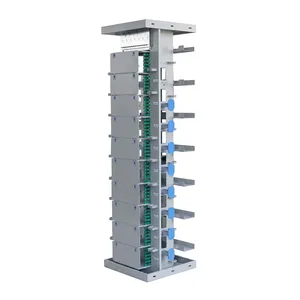
JODF-A1 Optical Distribution Frame
720-port 42U main distribution frame for GW-scale AI data center cross-connects and backbone termination
View Product →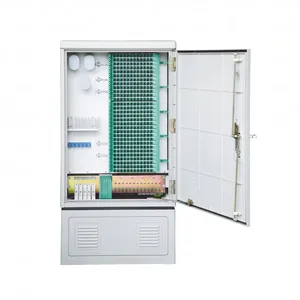
JFDC-288A Fiber Distribution Cabinet
288-port SMC outdoor cabinet for inter-building fiber routing on multi-acre AI data center campuses
View Product →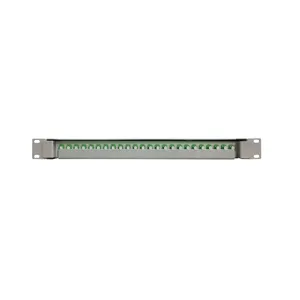
JODF-U3A Optical Patch Panel
24–96 port sliding rack-mount patch panel for GB200 NVL72 GPU cluster connections in AI racks
View Product →Related Articles

AAOI Q2 2026: Optical Module Capacity Triples
AAOI scales from 200K to 650K transceivers per month — what the capacity ramp means for passive fiber infrastructure
Read Article →
Corning Q2 2026: AI Drives Fiber Expansion
Corning reports accelerating data center fiber demand driven by AI infrastructure buildout
Read Article →
Furukawa ¥100B Fiber Capacity Doubling
Furukawa invests 100 billion yen to double optical fiber capacity — what ODN buyers need to know
Read Article →