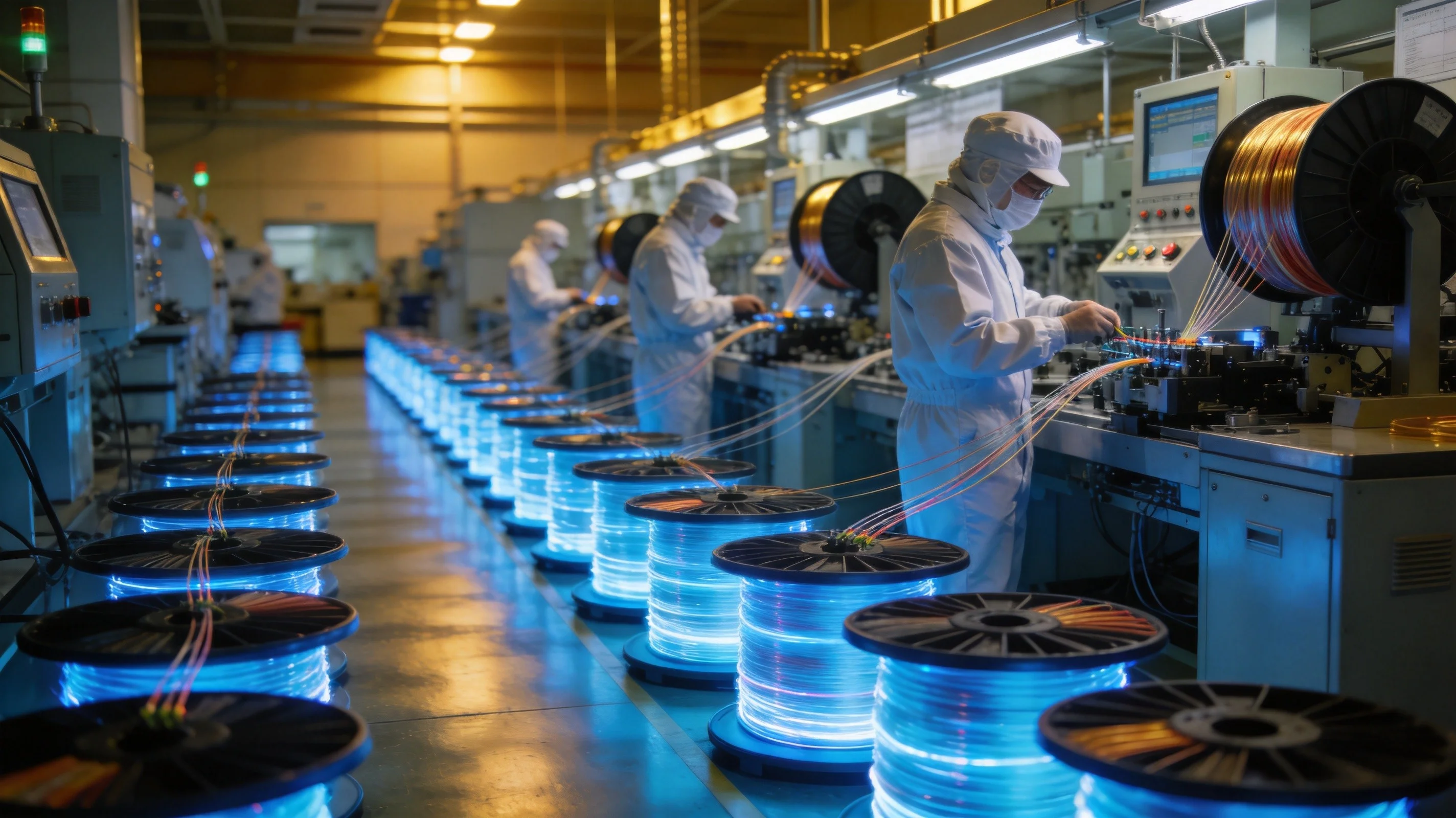
Hollow Core Fiber Powers HKT's 3.2Tbps AI DCI Link — But Scale Is Years Away
By Jergeo Engineering Team | August 6, 2026 · Based on Submarine Networks and RCR Wireless / CRU Group reports

Summary
HKT launched a 3.2Tbps AI data center interconnect superhighway in July 2026, using hollow core fiber from YOFC on its Lok Ma Sha to Tseung Kwan O route. YOFC confirmed delivery of over 10,000 fiber-kilometers with 0.04 dB/km attenuation. But CRU Group puts the cost at $3,000-5,000 per fiber-kilometer with yield around 10%, and cost parity at least a decade away. Hollow core fiber solves a real latency problem, but remains niche. The real signal for ODN buyers: AI-driven DCI buildout keeps accelerating.
Hong Kong's HKT just did something that no commercial operator in Asia-Pacific had done before. In July 2026, the company announced a 3.2Tbps AI data center interconnect — branded as a "superhighway" — running from Lok Ma Sha in the Shenzhen-Hong Kong Science and Technology Innovation Cooperation Zone (the so-called Loop) to Tseung Kwan O, with planned extension to Sha Ling. And the key part of the link uses hollow core fiber, the kind of optical fiber that most network engineers still consider experimental.
It's a genuine milestone. But before anyone starts rethinking their entire fiber procurement strategy, it's worth looking at the economics.
What Hollow Core Fiber Actually Solves
The pitch is straightforward. Standard solid-core fiber slows light down by about 30% because the glass core has a higher refractive index than air. Hollow core fiber flips this: light travels through air inside the fiber, so signals move close to the speed of light in vacuum. For a 30-kilometer DCI link — typical distance between data centers in a metro area — this shaves roughly 50 microseconds off latency.
That might sound trivial. It's not. In high-frequency trading, 50 microseconds is the difference between profit and loss. For AI training clusters where thousands of GPUs synchronize gradients across data centers, every microsecond of round-trip latency translates directly into training efficiency. And for financial exchanges migrating to AI-driven real-time settlement, both advantages matter at once.
The technology also eliminates nonlinear effects — the signal distortion that accumulates over distance in solid-core fiber and limits how much power you can pump into a single wavelength. With nonlinear effects gone, bandwidth potential pushes past 200 THz. That's a lot of headroom.
The Cost Problem Nobody Has Solved Yet
Here's where reality bites. According to CRU Group analyst Ahmed Ali, hollow core fiber currently costs $3,000-5,000 per fiber-kilometer. Standard single-mode fiber runs about $10-20 per fiber-kilometer. That's a 150-250x premium.
The root cause is manufacturing. Making hollow core fiber means building a microstructured preform with precisely arranged air channels running the full length, then drawing it into fiber while maintaining those structures. It's hard. Ali puts current manufacturing yield at roughly 10%. That means 90% of what goes in comes out as scrap.
And it's not just the fiber itself. The entire ecosystem around it is immature. Connectors for hollow core fiber are not interchangeable with standard connectors. Splicing requires different equipment and techniques. Testing instruments are still being developed. Every major supplier — YOFC, Lumentum, former Microsoft spinoff Lumenisity — has its own proprietary approach. There is no industry standard yet.
Ali's estimate: cost parity with standard fiber is at least 10 years away. That puts it around 2036 or later.
YOFC's Role: From Chinese Supplier to Global Hollow Core Fiber Leader
Yangtze Optical Fibre and Cable (the world's largest fiber maker by volume) confirmed in August 2026 that it supplied the hollow core fiber for the HKT deployment. The numbers are notable:
- Cumulative delivery exceeding 10,000 fiber-kilometers of hollow core fiber cable
- Minimum attenuation of 0.04 dB/km — competitive with early solid-core fiber from the 1990s
- Single continuous draw of 91.2 km, demonstrating production consistency
- Involvement in 13+ commercial or pilot projects globally
This is a meaningful step up from where the technology was even 18 months ago. YOFC's 91.2 km draw length is particularly important — long continuous runs are what make DCI deployment practical without needing regenerators every few kilometers.
China's Hollow Core Fiber Track Record
HKT isn't the first to deploy hollow core fiber commercially. Chinese carriers have been moving faster than most Western observers realize:
- China Mobile launched its first commercial hollow core fiber line in 2025, built on self-developed fiber, in the Greater Bay Area connecting Hong Kong-adjacent cities
- China Unicom established a hollow core fiber interconnect between Shenzhen and Hong Kong in late 2025
- China Telecom, working with YOFC and Deyeke, demonstrated 51.3 Tbps over 206.5 km without optical regeneration in June 2026 — a world record for hollow core fiber transmission
The pattern here is clear: China's three major carriers treat hollow core fiber as a strategic technology and are running parallel commercialization programs. This is consistent with the country's broader approach to next-generation fiber optics — see our analysis of Shiji Photonics' 1.6T AWG shipment for another example of China accelerating optical component production for AI infrastructure.
Who Can Actually Afford Hollow Core Fiber Right Now?
CRU Group's assessment is blunt: only two categories of buyers are deploying hollow core fiber today. Hyperscale operators — think the Microsofts and Googles running AI training clusters — and Chinese telecoms backed by national infrastructure budgets.
For everyone else, the math doesn't work yet. A typical DCI deployment runs 10-40 km. At $3,000-5,000 per fiber-kilometer, a 96-fiber hollow core link spanning 20 km costs roughly $6-10 million in fiber alone. The same link in standard fiber would cost $30,000-50,000. For enterprise data centers, regional carriers, and most ISPs, that gap is unbridgeable.
The typical deployment distance of 10-40 km also limits the addressable market. Long-haul routes — the kind of routes where fiber cost per kilometer matters most for total project budgets — are not the right use case for hollow core fiber yet. The technology's advantage is in short-to-medium metro links where latency is the primary constraint, not raw cost.
What This Means for ODN Infrastructure Procurement
Hollow core fiber will not change how you spec your next ODN deployment. It's too expensive, too niche, and the ecosystem is too fragmented for that. But the HKT superhighway and similar deployments point to a larger trend that directly affects passive infrastructure demand.
AI data center interconnects are getting bigger and more numerous. Every new DCI link — whether it uses hollow core fiber, multicore fiber, or standard single-mode — needs optical distribution frames at the termination points. It needs splice closures along the route. It needs fiber distribution cabinets at outdoor handover points. The fiber type changes; the passive infrastructure requirements don't.
ODF Demand from DCI Buildout
Data center interconnects require high-density optical distribution frames for cross-connecting multiple fiber routes. As operators like HKT deploy 3.2Tbps and higher-capacity links, the ODF configurations at each endpoint need to handle increasing fiber counts and higher-density adapter layouts. The JODF-U3A optical distribution frame is designed for exactly this kind of high-density indoor termination.
Splice Closures for Specialty Fiber Routes
Hollow core fiber has different bending radius and environmental protection requirements than standard fiber, but the basic principle holds: every outdoor joint point needs a sealed closure. As more specialty fibers — hollow core, multicore, thin-clad — enter deployment, splice closure designs may need to evolve. For now, standard high-capacity splice closures handle the majority of DCI route joints.
Fiber Distribution Cabinets at Campus Boundaries
Where DCI routes enter data center campuses or carrier-neutral facilities, outdoor-to-indoor transition points require fiber distribution cabinets. The accelerating pace of DCI construction — Corning's 10x fiber capacity expansion, Japanese manufacturers' 400 billion yen combined investment, and now hollow core fiber deployments — all point to the same conclusion: more fiber routes mean more distribution cabinets at more locations.
The Real Takeaway
Hollow core fiber is real technology solving a real problem. HKT's 3.2Tbps superhighway proves it works in commercial service, not just in a lab. YOFC's 10,000 fiber-kilometer delivery shows it's manufacturable at meaningful scale — even if "meaningful scale" in hollow core fiber is still tiny compared to standard fiber production.
But here's the honest assessment: hollow core fiber will remain a premium niche product for the rest of this decade. The cost structure, the manufacturing yield, the fragmented ecosystem — none of these change quickly. If your procurement plan doesn't account for hollow core fiber, that's fine. You're not missing anything urgent.
What you should be paying attention to is the underlying demand driver. The fact that HKT built a 3.2Tbps AI DCI link — using the most advanced fiber available, at whatever cost — tells you that AI data center interconnect demand is intense enough to justify premium technology. That demand drives all fiber deployment, and all fiber deployment drives ODN equipment. The hollow core fiber is just the leading edge of a much larger wave.
Related Products
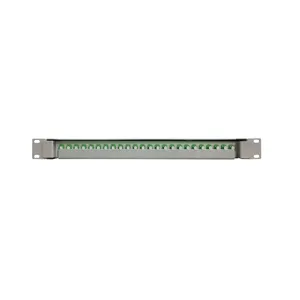
JODF-U3A Optical Distribution Frame
High-density ODF for data center main cross-connect and DCI termination
View Product →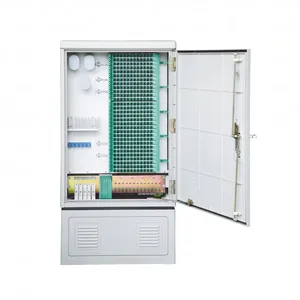
JFDC-288A Fiber Distribution Cabinet
Outdoor fiber management cabinet supporting up to 288 fiber cores for campus deployment
View Product →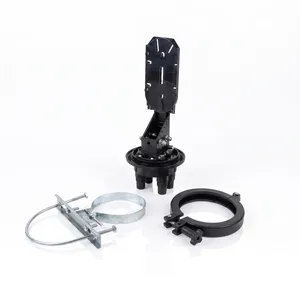
JFSC-L144A Fiber Splice Closure
Horizontal splice closure supporting 144 cores for outdoor fiber joint protection
View Product →