Corning Expands US Optical Fiber Capacity 10x for NVIDIA AI Factories — What It Means for ODN Equipment
By Jergeo Engineering Team | July 29, 2026 · Based on Corning Q2 2026 earnings release

On July 28, 2026, Corning Incorporated (NYSE: GLW) reported second-quarter results that confirm what the ODN equipment industry has been observing firsthand: AI infrastructure buildout is driving record demand for optical fiber and connectivity products. The company's Optical Communications segment posted $2.07 billion in quarterly revenue — up 32% year-over-year — while Enterprise Networks, which includes data center connectivity products, surged 65%. Generative AI product sales are growing even faster than that.
Summary
Corning is expanding US optical connectivity manufacturing capacity 10x and fiber production 50%+ to meet AI demand it literally cannot fulfill fast enough. For ODN equipment suppliers, this is a clear signal that passive fiber infrastructure demand is structurally accelerating — every new fiber deployed needs patch panels, ODFs, and distribution cabinets to terminate and manage it.
"We continue to have the enviable situation of if we could make more, we could sell more," said CEO Wendell Weeks on the earnings call. That statement — from the world's largest optical fiber manufacturer — should be read carefully by anyone in the fiber infrastructure supply chain.
The Numbers Behind Corning's AI Surge
Corning's Q2 results paint a clear picture of where the demand is coming from:
- Optical Communications revenue: $2.07 billion, up 32% year-over-year
- Enterprise Networks growth: 65% increase, driven by AI data center connectivity
- Core operating margin: 20.9%, up 190 basis points — indicating pricing power and volume
- Adjusted free cash flow: $1.42 billion, funding aggressive capacity expansion
- 2026 capital expenditure plan: approximately $2 billion, concentrated in H2 for Optical Communications capacity
The company now targets an annualized revenue run rate of $20 billion by end of 2026, $30 billion by 2028, and $40 billion by 2030 — a 19% compound annual growth rate. This "Springboard Plan" is underpinned by binding multi-year agreements with the largest technology companies in the world.
Two Landmark Deals: NVIDIA and Amazon
During Q2, Corning locked in two partnerships that significantly reshape its manufacturing footprint:
NVIDIA: 10x Optical Connectivity Capacity
Under a long-term partnership with NVIDIA, Corning will expand its U.S. optical connectivity manufacturing capacity by 10 times and increase domestic fiber production capacity by more than 50%. The expansion includes three new manufacturing facilities in North Carolina and Texas, creating at least 3,000 jobs. The purpose is explicit: to support AI factory buildouts powered by NVIDIA GPUs.
"AI is driving the largest infrastructure buildout of our time," said NVIDIA CEO Jensen Huang. "Together with Corning, we are inventing the future of computing with advanced optical technologies building the foundation for AI infrastructure where intelligence moves at the speed of light."
Amazon: Multi-Billion Dollar Multi-Year Supply Agreement
Separately, Amazon signed a multiyear, multibillion-dollar agreement under which Corning will supply optical fiber, cable, and connectivity solutions supporting Amazon's expanding U.S. data center infrastructure. Combined, these two agreements mean Corning's optical production capacity for the next several years is essentially committed — and the company is still expanding as fast as it can.
What This Means for ODN Equipment Demand
Corning makes the fiber. But fiber does not deploy itself. Every meter of optical fiber needs termination points, management infrastructure, and physical protection — all of which are ODN (Optical Distribution Network) equipment. When the world's largest fiber maker is expanding capacity 10x, the downstream passive infrastructure supply chain must scale accordingly.
More Fiber Means More Patch Panels, More ODFs, More Cabinets
The relationship is direct and proportional:
- Fiber patch panels: every fiber strand terminates at a patch panel. A 10x increase in connectivity products means a corresponding increase in adapter ports, splice trays, and patch panel chassis
- Optical distribution frames (ODFs): main cross-connect points in data center meet-me rooms scale with total fiber count. Higher-density AI clusters require even more ODF capacity per rack
- Fiber distribution cabinets: campus-level distribution points that aggregate and protect fiber connections between buildings. Every new data center campus needs dozens of outdoor FDCs
- Splice closures: dome and inline closures protect fiber joints in underground and aerial routes. As fiber routes multiply, closure counts multiply
AI Clusters Multiply Fiber Density Per Rack
It is not just about total fiber volume — AI architectures are changing the fiber-to-rack ratio. Traditional enterprise data center racks typically use 12–48 fiber ports. AI training clusters with high-density GPU configurations require 96–192 fiber ports per rack — a 4-to-8x increase. As NVIDIA's Vera Rubin architecture introduces optical scale-up (replacing copper in the compute cluster backbone), the fiber content per GPU could increase by an order of magnitude.
CEO Weeks quantified this on the earnings call: if scale-up networks transition from all-copper to all-optical, combined with scale-out requirements, the fiber content per AI factory increases dramatically. This is a structural shift in how much passive optical infrastructure each data center requires.
The Copper-to-Optical Transition Creates New ODN Categories
Corning is also expanding into silicon photonics (SiPh) and co-packaged optics (CPO) — moving optical connectivity from "between racks" to "inside the box." While this represents a different product category than traditional ODN equipment, the underlying principle remains the same: as optical penetration increases in AI infrastructure, the total addressable market for fiber management hardware grows. Even CPO-based systems require external fiber breakout, patching, and distribution — just at higher densities and tighter specifications.
Supply Chain Implications for ODN Manufacturers
Corning's capacity constraint is the ODN industry's opportunity. If Corning — with $2 billion in annual capex and the backing of NVIDIA and Amazon — cannot produce enough optical connectivity products to meet demand, then the broader ecosystem of passive fiber infrastructure must also scale up. Key implications:
- Volume pressure: data center construction timelines are aggressive. Operators need ODN equipment delivered on schedule to avoid delaying GPU installation
- Density requirements: AI data centers prefer high-density, modular ODN solutions that can be deployed incrementally as capacity scales — sliding ODF trays, expandable cabinet configurations, pre-terminated MPO cassettes
- Quality standards: with AI data centers operating 24/7 at full capacity, fiber infrastructure must maintain reliability under continuous operation. IP65-rated outdoor cabinets, corrosion-resistant SMC materials, and precision-machined adapter plates become procurement requirements, not options
- Global buildout: this is not limited to the United States. Corning is also opening new fiber manufacturing in Poland and expanding cable production globally. Every region building AI data center capacity needs the same passive infrastructure
Jergeo Fiber Infrastructure for AI Data Centers
As hyperscalers and AI companies accelerate data center construction globally, the passive fiber infrastructure layer must keep pace. Jergeo Fiber Patch Panels support high-density MPO/LC configurations in standard 19" rack-mount form factors, designed for the dense interconnect requirements of GPU cluster architectures.
For campus-level distribution, Jergeo Fiber Distribution Cabinets are available in SMC and stainless steel with IP65/IP67 ratings, supporting up to 288 ports in compact, weatherproof enclosures engineered for 25-year service life.
For main cross-connect rooms, Jergeo Optical Distribution Frames provide sliding-tray designs supporting up to 1,440 ports per frame — scalable from initial deployment through phased AI capacity expansion.
View All ODN ProductsRelated Products
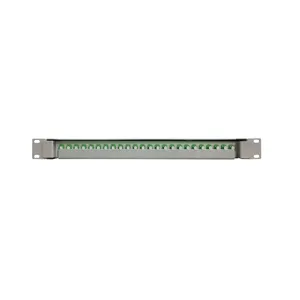
JODF-U3A Optical Patch Panel
24-96 ports sliding type patch panel for data centers
View Product →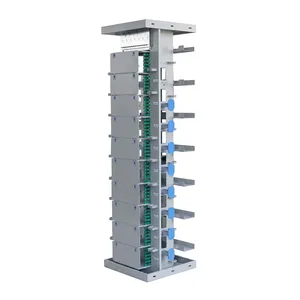
JODF-A1 Optical Distribution Frame
720 ports ODF with 42U capacity for main cross-connects
View Product →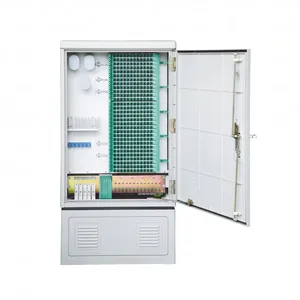
JFDC-288A Fiber Distribution Cabinet
288 ports FDC with wall/pole mounting options
View Product →Sources
This article is based on Corning's official Q2 2026 earnings release (investor.corning.com, July 28, 2026) and earnings call transcripts. All financial figures, quotes, and partnership details are sourced directly from Corning's official disclosures. Additional context from Converge Digest and Sina Finance.