China Mobile's Fiber Procurement Surge and One Failed Bid Tell the Same Story: FTTX Demand Is Outpacing Supply
By Jergeo Engineering Team | August 9, 2026 · Based on reporting from China Mobile Procurement and industry analysis

Summary
China Mobile, the world's largest mobile operator by subscriber count, just had a major fiber optic cable tender fail. The 69.22 million fiber-kilometer G.652D standard cable procurement, opened on August 5, 2026, drew too few valid bidders because the internal price cap — roughly 70–72 RMB per fiber-km — is far below current spot market prices. The same week, China Mobile awarded a special optical fiber tender, issued a 10.58-million-set splice closure procurement, and pushed forward with 50G PON deployment across the country. Taken together, these moves tell a clear story: FTTX demand is accelerating, fiber supply is structurally tight, and the entire ODN equipment supply chain needs to plan for a sustained wave of deployment.
China Mobile's G.652D standard fiber cable tender failed on August 5, 2026. The largest telecom operator in the world, buying nearly 70 million fiber-kilometers of standard cable, could not get enough manufacturers to bid. The tender was declared void because the number of valid bidders fell short of the legal minimum.
The reason is straightforward. China Mobile's internal price ceiling was set at roughly 70–72 RMB per fiber-kilometer, including tax. The current spot market price for G.652D bare fiber is much higher. Ground cable fiber trades at 100–110 RMB per fiber-km. A1-grade fiber sits at 145–165 RMB per fiber-km. Standard A2 fiber is at 210–220 RMB, and high-end A2 fiber can reach 280 RMB. No manufacturer is going to bid on a contract where the ceiling price is 30–50% below their raw material cost.
This is not a temporary blip. Fiber producers have been shifting production capacity away from standard G.652D cable and toward higher-value products — G.654E for long-haul, G.657A2 for bend-insensitive FTTH, and specialty fiber for AI data center applications. Standard cable is a low-margin, high-volume business, and when specialty fiber demand is strong, manufacturers simply reallocate their draw towers to the products that pay more.
The Special Fiber Tender: Hengtong, YOFC, FiberHome, and Tongding Split the Pie
If the failed G.652D tender shows what happens when price meets reality in the standard fiber market, the special optical fiber tender shows where the industry's attention has actually shifted. On August 9, 2026, results from China Mobile's 2026–2027 special optical fiber tender were circulated in industry channels.
Four groups won the contract:
- Hengtong Group: 34.78% share — the largest winner.
- YOFC (Yangtze Optical Fiber and Cable): 23.19% share.
- FiberHome: 23.18% share.
- Tongding Interconnect: 18.85% share — reportedly won through aggressive price cutting, giving up an estimated 13 million RMB in profit to gain share.
The concentration of winners is not surprising. China's special fiber market is dominated by a handful of large integrated players with their own preform, fiber draw, and cable production. What stands out is the competitive intensity — Tongding's willingness to accept thinner margins to secure a larger slice of the special fiber market tells you how valuable that volume has become relative to standard cable.
10.58 Million Splice Closures: The ODN Side of the Procurement Wave
On August 7, 2026, China Mobile published another major procurement — this time for fiber optic splice closures. The estimated volume is 10.583 million sets over the 2026–2028 period, with an option to extend for one more year.
The tender is split into three lots:
- Lot 1 — Single-end fiber optic splice closures: 508,400 sets.
- Lot 2 — Double-end multi-branch fiber optic splice closures: 399,900 sets.
- Lot 3 — Double-end fiber optic splice closures: 9.6747 million sets.
The requirements are strict. Only direct manufacturers can bid — no agents, no trading companies, no consortia. Bidders must also show cumulative domestic sales of at least 10 million RMB in splice closures between July 2024 and June 2026. The bidding deadline is September 3, 2026.
Ten and a half million splice closures is a lot of hardware. Each splice closure represents a physical junction point in the fiber network — where feeder cables branch into distribution cables, where distribution cables drop to neighborhood access points, or where underground cable segments are joined. The volume alone gives you a sense of how much fiber is going into the ground over the next two to three years.
50G PON and the Wan-Ge Guangwang Push
All of this fiber and all of these splice closures are not just sitting in the ground. They connect to active equipment at both ends, and that equipment is also scaling up fast. China's "10G PON Scale-up and 50G PON Pilot" program has been moving faster than many expected.
Here are the numbers from the most recent round of official reporting:
- 136 10G PON pilot projects have passed inspection by the Ministry of Industry and Information Technology (MIIT).
- 32.86 million 10G PON ports are deployed nationwide, covering more than 500 million households.
- China Mobile led 83 out of 168 national pilot sites.
- The 15th Five-Year Plan targets 1 million 50G PON ports nationwide.
- China Mobile is expected to add roughly 200,000 50G PON ports in 2026 alone.
- Sichuan Province has completed 50G PON deployment across all 21 of its prefecture-level cities — the first province to reach full coverage.
- FTTR (fiber-to-the-room) deployment is moving in parallel with Wi-Fi 7, creating a coordinated home network upgrade cycle.
The upgrade path from 10G PON to 50G PON is not just about swapping out line cards in the central office. It is a full-stack upgrade that reaches into the distribution network. Higher bit rates require tighter optical budgets, better splice quality, cleaner connector end-faces, and in many cases, new distribution hardware designed for the higher power levels and tighter loss budgets of 50G PON systems.
Why Fiber Prices Keep Going Up: The Structural Story
Spot fiber prices in China have been climbing steadily, and the drivers are structural, not temporary. On the demand side, two forces are pulling in the same direction. FTTX deployment is accelerating as operators push toward 50G PON and expand fiber coverage to more households and businesses. AI data center fiber demand is also growing fast — industry estimates put AI DC fiber consumption at roughly 100 million fiber-km in 2026, doubling to about 200 million fiber-km in 2027.
On the supply side, fiber producers have been shifting draw tower capacity toward higher-margin products. G.654E for long-haul, G.657A2 for bend-insensitive FTTH, and various specialty fibers for data center interconnect all carry better margins than standard G.652D. When demand for those products is strong, standard cable becomes the swing product — the one that gets deprioritized when capacity is tight.
That is exactly what is happening now. The failed China Mobile tender is not an isolated incident. It is a symptom of a market where standard fiber capacity is no longer freely available at the prices operators have historically expected.
What This Means for ODN Infrastructure
For anyone working on the passive side of the fiber network — the cabinets, frames, enclosures, and panels that hold it all together — the procurement wave from China Mobile has implications across the ODN supply chain.
First, the volumes are real. 69.22 million fiber-km of cable, even if the first tender failed, will get re-bid at a higher price. 10.58 million splice closures is a concrete number with a defined timeline. 200,000 50G PON ports in 2026, scaling toward a million by 2030, is a deployment curve you can plan against. Each of these numbers drives demand for the full ODN stack — from central office ODFs to street-level FDCs to underground splice closures.
Second, the shift toward higher-value fiber and higher-speed PON technologies changes the requirements for passive equipment. 50G PON runs at tighter loss budgets. Bend-insensitive fiber changes how cable is routed and how slack is stored. Specialty fiber for data center applications requires different handling and termination. The ODN equipment that works fine at 1G and 10G PON speeds may not be adequate for 50G. Buyers need to plan now, not wait until the fiber is in the ground.
Third, the supply tightness in raw fiber is actually a positive signal for ODN equipment demand. When fiber is cheap and abundant, operators can afford to be casual about how they terminate and manage it. When fiber is expensive and capacity-constrained, every fiber count matters. The quality of splice closures, the density of distribution frames, and the efficiency of fiber routing all have a direct impact on how much usable capacity you get out of each fiber-km. That is when the passive infrastructure layer stops being a commodity and starts being a strategic part of the network design.
China Mobile is not the only operator buying. China Telecom's recent FTTR framework agreement with Tianyi (valid through April 2027) points to the same trend on the in-home side. China Unicom has its own procurement cycles. The entire Chinese telecom industry is in an upgrade phase, and the passive ODN layer is where a lot of that upgrade effort lands.
The failed G.652D tender is a wake-up call. It tells operators that the era of cheap, abundant standard fiber is over, at least for now. It tells suppliers that pricing power is shifting back toward producers of both fiber and the equipment that goes with it. And it tells everyone in the ODN industry that the next several years are going to be busy — with fiber deployment, PON upgrades, and a growing backlog of demand that the supply chain needs to figure out how to meet.
Jergeo ODN Equipment for FTTX and 50G PON Deployment
As China Mobile and other operators scale up fiber deployment and move toward 50G PON, the quality and capacity of passive ODN infrastructure directly determines network performance. Jergeo Fiber Distribution Cabinets deliver 72–1,152 port configurations in SMC and stainless steel enclosures with IP65/IP67 ratings — designed for the harsh outdoor conditions of FTTX access networks and 50G PON distribution points.
In central offices and headend facilities, Jergeo Optical Distribution Frames provide scalable fiber termination and cross-connect capacity with modular sliding-tray designs that support phased deployment from initial 10G PON rollout through future 50G PON upgrades.
For underground and aerial fiber cable junctions in FTTX feeder and distribution networks, Jergeo Fiber Splice Closures — including horizontal and dome types from 24 to 288 cores — provide reliable mechanical sealing and fiber management for direct buried, aerial, and pipeline installations.
Explore FTTX SolutionsRelated Products
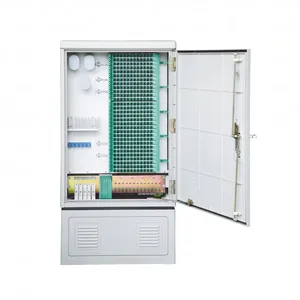
JFDC-288A Fiber Distribution Cabinet
288-port SMC outdoor cabinet for FTTX street-level fiber distribution and 50G PON access points
View Product →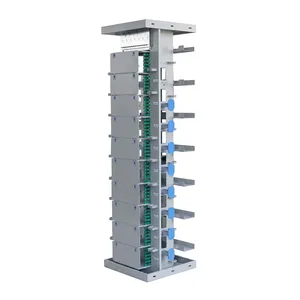
JODF-A1 Optical Distribution Frame
720-port 42U main distribution frame for central office PON line card termination and cross-connect
View Product →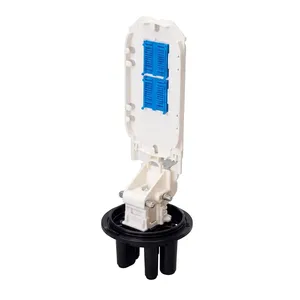
JFSC-L96A Fiber Splice Closure
96-core horizontal splice closure for underground and aerial FTTX feeder cable junctions — IP65 rated
View Product →Related Articles

NVIDIA Invests $3B in Lancium Power Infrastructure
NVIDIA commits up to $3B to power developer Lancium for Stargate AI data centers — what the power-constrained era means for fiber infrastructure
Read Article →
FTTH Deployment Trends 2026
Global FTTH deployment trends, 50G PON timelines, and what the next wave of fiber buildout means for ODN equipment
Read Article →
Hollow Core Fiber Powers HKT's AI DCI Link
HKT deploys 3.2Tbps AI DCI using hollow core fiber from YOFC — why cost parity is still 10+ years away
Read Article →