US$24.98M AIDC Prefab Module Contract Signals Accelerating Southeast Asia Data Center Buildout
By Jergeo Engineering Team | July 27, 2026 · Based on China United Development Holdings (HK:00264) stock exchange disclosure
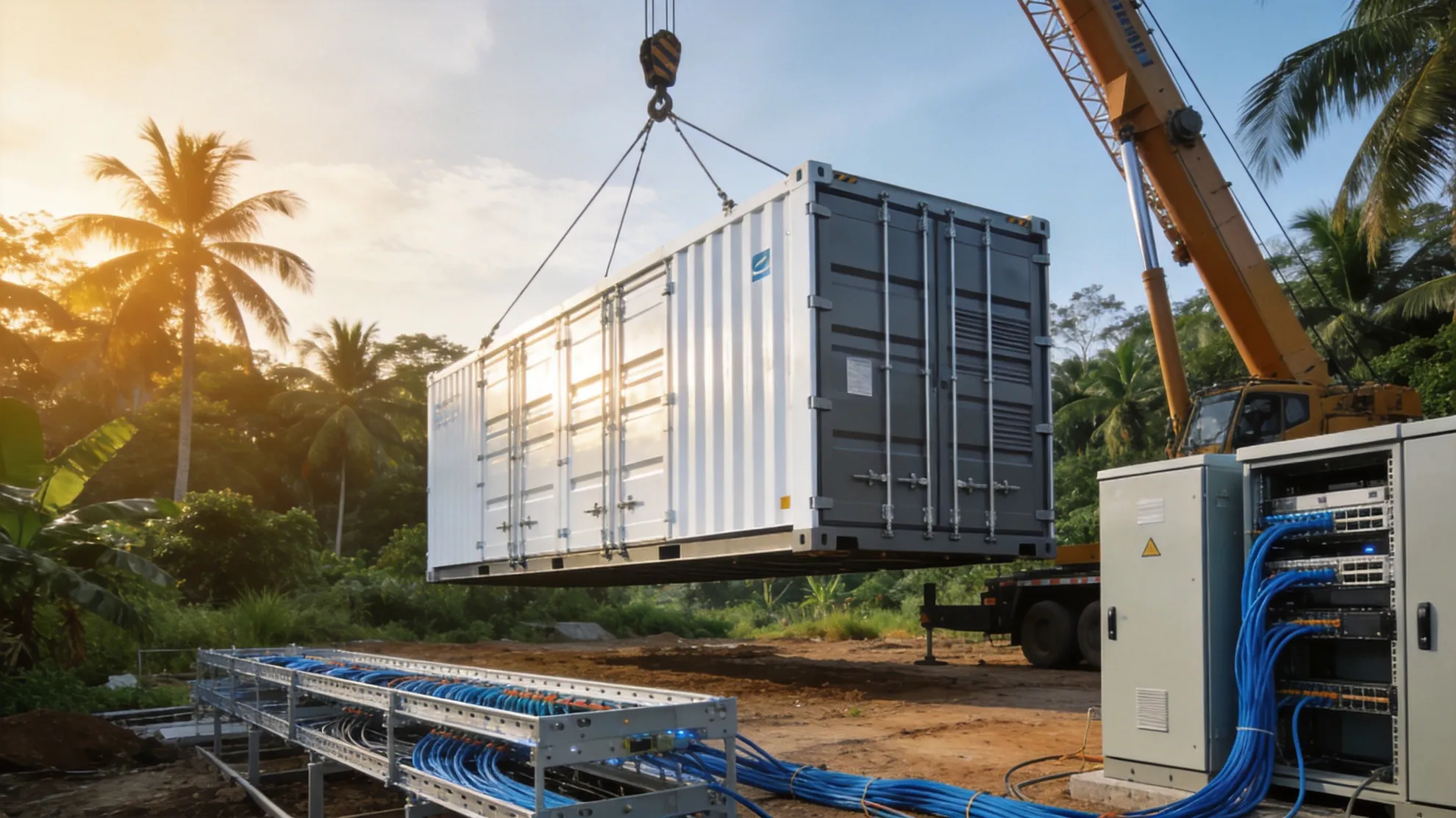
On July 26, 2026, China United Development Holdings (HK:00264) announced that its joint venture subsidiary Ganic Synergy signed a procurement services contract with Brightray Veridian PTE. LTD. valued at approximately US$24.98 million (HK$195.96 million). Under the contract, the service company will supply customized pre-fabricated AI data center (AIDC) modules and provide ocean freight, acceptance testing, and on-site installation services for a project in Johor Bahru, Johor, Malaysia.
Summary
AI data center prefab modules are being deployed in Malaysia, using factory-assembled ODF and patch panel racks that snap into standardized frames for faster commissioning.
The contract is particularly notable because it represents a conversion from priority supply rights to actual orders. In June 2026, the joint venture was granted priority supply rights for pre-fabricated AIDC modules by Shanghai Deheng Data Technology — a strategic partner. This latest contract demonstrates that the priority rights have translated into confirmed commercial commitments within just two months.
The company also disclosed that it is in "close consultation" with the customer regarding remaining orders for the project, suggesting the total contract value may increase further.
Why Prefab AIDC Modules Are the Fastest-Growing Data Center Format
Pre-fabricated modular data centers represent the next evolution in computing power infrastructure deployment. Unlike traditional data center construction — which typically takes 18–36 months from ground-breaking to commissioning — prefab AIDC modules can be manufactured, tested, shipped, and installed in weeks. This speed advantage is critical in the current AI infrastructure race, where time-to-capacity directly translates to revenue.
Key characteristics of prefab AIDC modules:
- Factory pre-assembly: All mechanical, electrical, cooling, and IT infrastructure is integrated and tested before shipment, reducing on-site commissioning time by 60–80%
- Standardized transport: Modules are designed for container shipping, enabling rapid deployment to international sites
- Scalable architecture: Additional modules can be added incrementally as capacity demands grow
- High-density optimized: Purpose-built for AI workloads with integrated liquid cooling interfaces, high-power distribution, and dense fiber connectivity
Johor Bahru: Southeast Asia's Emerging Data Center Hub
The project location — Johor Bahru, Malaysia — is strategically significant. Johor borders Singapore, one of Asia's primary data center markets. As Singapore tightens land use restrictions and power allocation for new data center builds, Johor has emerged as the natural overflow market, offering lower land costs, available power capacity, and geographic proximity to Singapore's carrier hotels and internet exchanges.
Multiple hyperscalers and AI companies have announced or are planning data center campuses in Johor state. The region is experiencing a construction boom that mirrors the early-phase buildout happening in other Southeast Asian markets including Indonesia (Batam, Jakarta), Thailand (Bangkok), and the Philippines (Clark, Manila).
For equipment suppliers, this geographic concentration of projects means that a single procurement decision can cascade into multi-site, multi-phase orders across the region.
What Prefab AIDC Means for Fiber Distribution and ODN Equipment
Each pre-fabricated AIDC module is essentially a self-contained data center unit. Regardless of how compact the design, every module requires complete fiber connectivity infrastructure — and because modules are standardized, the fiber distribution requirements are consistent and predictable across deployments.
Fiber Requirements Inside Each Module
- High-density patch panels: AI compute racks inside prefab modules typically require 96–192 fiber ports per rack (vs. 12–48 in traditional IT). Each module may contain 20–40 racks, generating 2,000–8,000 fiber connections per unit
- Mixed connector environments: Modules must support both MPO/MTP for high-speed interconnects (400G/800G) and LC for management and legacy interfaces — often in the same panel chassis
- Pre-terminated solutions preferred: Because modules are factory-assembled, pre-terminated fiber cabling and patch panels reduce on-site installation time and improve quality consistency
External Fiber Infrastructure per Deployment Site
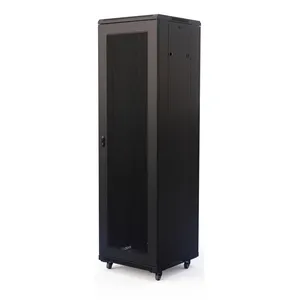
- Outdoor fiber distribution cabinets (FDC): each prefab module site needs weatherproof entry points for carrier fiber, campus backbone cables, and inter-building connections. SMC or stainless steel enclosures with IP65/IP67 ratings are essential for tropical climates like Malaysia's
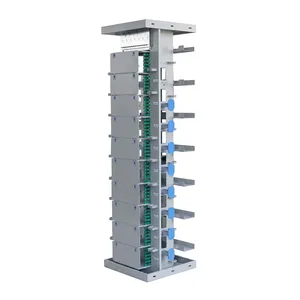
- Optical distribution frames (ODF): meet-me rooms and cross-connect points at each data center campus require high-capacity ODFs with sliding tray designs for easy maintenance access
- Fiber splice closures: underground and aerial cable routes between modules and to external carrier networks need dome and inline splice closures rated for outdoor deployment
The Multiplier Effect
The key insight for ODN equipment procurement is the repeatability factor. When a prefab AIDC supplier wins a $25 million contract for one project, the fiber distribution requirements are not a one-time purchase — they repeat for every additional module deployed at the same site, and for every new site the operator develops. The US$24.98M contract disclosed by China United Development Holdings covers an initial order, but the company has indicated remaining orders are under negotiation. For fiber management infrastructure, this means sustained procurement volume over multiple deployment phases.
The Cross-Industry Transformation Signal
What makes this particular contract noteworthy beyond the dollar amount is who is involved. China United Development Holdings' core business historically includes leather manufacturing, fashion retail, and industrial hemp cultivation — not data center infrastructure. The fact that a traditional manufacturing company can pivot into AIDC module supply within months, leveraging strategic partnerships with specialized data center equipment manufacturers like Shanghai Deheng, illustrates how the AI infrastructure supply chain is opening up to new participants.
This pattern — traditional manufacturers entering the data center supply chain through partnerships rather than building capabilities from scratch — is likely to accelerate as the prefab module format standardizes the technology stack and reduces barriers to entry.
The Bottom Line
The US$24.98M AIDC prefab module contract for Malaysia is a concrete data point confirming three trends: (1) AI data center construction is moving from planning to execution at scale; (2) prefabricated modular formats are winning market share due to deployment speed; and (3) Southeast Asia — particularly Malaysia's Johor state — is emerging as a major construction hotspot. For the ODN equipment supply chain, every prefab module deployed means corresponding demand for fiber distribution cabinets, optical distribution frames, patch panels, and splice closures. The procurement wave is real, and it is accelerating.
Jergeo Fiber Distribution Equipment for Prefab & Modular Data Centers
Pre-fabricated AIDC modules require fiber distribution infrastructure that matches their deployment speed and density requirements. Jergeo Fiber Distribution Cabinets are available in SMC and stainless steel construction with IP65/IP67 ratings — engineered for outdoor deployments in tropical climates like Malaysia and Southeast Asia. Our JFDC series supports up to 288 ports in compact form factors, designed for the phased expansion model that modular data centers require.
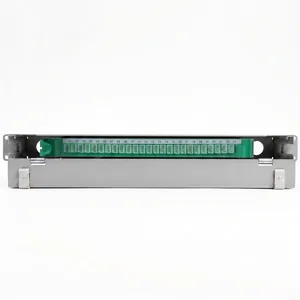
For indoor high-density environments, Jergeo Optical Distribution Frames feature sliding tray designs supporting LC, SC, and MPO connectors in the same chassis — essential for the mixed-architecture environments inside prefab AIDC modules. High-density patch panels with pre-terminated options reduce installation time and ensure consistent quality across module deployments.
Explore AI Data Center SolutionsRelated Products
Sources
This article is based on China United Development Holdings (HK:00264) voluntary announcement dated July 26, 2026, as reported by Financial Times (财华社), Securities Star (证券之星), and Sina Finance (新浪财经). All contract values, parties, and project details are sourced directly from the stock exchange disclosure. Additional context on prefabricated data center market trends from Light Reading and CRU Group optical fiber market research.