AAOI Revenue Jumps 86% as Optical Module Capacity Triples — What It Means for ODN Fiber Infrastructure
By Jergeo Engineering Team | August 8, 2026 · Based on AAOI Q2 2026 earnings release

Summary
Applied Optoelectronics (AAOI) delivered its fifth consecutive record quarter with $191.9 million in Q2 2026 revenue, driven by a 140% surge in data center transceiver sales. The company is scaling monthly optical module production from 200,000 units today to 650,000 by year-end and 930,000 by end of 2027 — while demand still exceeds capacity by 20-40%. For the ODN passive infrastructure industry, the math is direct: every transceiver shipped requires fiber patch cables, termination panels, and distribution hardware. As 800G and 1.6T volumes ramp, the downstream demand for fiber distribution cabinets, optical distribution frames, and high-density patch panels is set to grow in lockstep.
Applied Optoelectronics, Inc. (NASDAQ: AAOI) reported second-quarter 2026 results on August 6 that tell a simple story: the market for high-speed optical transceivers is growing faster than anyone can build them. Total revenue reached $191.9 million, up 86.4% from a year ago and 27% from the previous quarter. Data center revenue alone was $107.7 million — up 140.4% year-over-year — and now accounts for 56% of the company's total sales.
The company, founded by CEO Thompson Lin and headquartered in Sugar Land, Texas (on the outskirts of Houston), operates manufacturing bases across three locations: Sugar Land, Taipei, and Ningbo, China. Its Texas manufacturing footprint alone exceeds 1.6 million square feet. That physical scale is about to get much larger.
The financial result is also worth highlighting. AAOI posted its first non-GAAP quarterly profit since 2023: $5.5 million, or $0.06 per share. GAAP results still show a net loss of $22.8 million ($0.28 per share), but the trajectory is clear. CEO Lin summarized it on the earnings call:
"Q2 was a pivotal quarter for AOI. We delivered record revenue for our fifth consecutive quarter and achieved an important milestone as we returned to non-GAAP profitability in the quarter."
— Thompson Lin, CEO, AAOI Q2 2026 Earnings Call
The Product Ramp: 400G, 800G, and the 1.6T Wave
Breaking down AAOI's transceiver revenue by speed grade shows where the growth is concentrated and where it is heading next:
- 400G transceivers: $48.4 million in Q2, up 4x year-over-year and 27.4% sequentially. Still the volume workhorse of AAOI's data center product line.
- 800G transceivers: $12.8 million in Q2, up roughly 10x year-over-year and more than doubling from Q1. This is the speed grade that is about to explode.
- 1.6T transceivers: over $200 million in orders already secured. First hyperscale customer certification expected "within weeks." Initial shipments targeted for late Q3 2026.
The 800G number deserves attention. CFO Stefan Murry guided that Q3 800G revenue is expected to grow nearly 5x from Q2 levels. That puts 800G revenue alone at roughly $60 million in Q3 — a massive jump in a single quarter and a clear inflection point for this product generation.
On the CATV side, revenue reached $80.6 million in Q2, up 43.8% year-over-year and also a record. The company is shipping 1.8GHz amplifier products in high volume to cable operators. Telecom revenue was smaller at $3.4 million but grew 75.8% from a year ago, reflecting early signs of carrier network refresh activity.
The product mix shift matters for the passive infrastructure supply chain. 800G and 1.6T transceivers use MPO connectors carrying 12 to 24 fiber strands per connection, compared to just 2 strands for legacy 100G LC-based modules. This means each transceiver shipped at higher speed grades pulls proportionally more fiber patch cables, adapter ports, and distribution hardware into the deployment.
AAOI Capacity Buildout: From 200K to 930K Units Per Month
The production capacity numbers are what matter most for the ODN supply chain. Here is the trajectory AAOI laid out on its earnings call:
- End of Q1 2026: approximately 100,000 transceiver units per month
- End of Q2 2026 (current): approximately 200,000 units per month — a doubling in a single quarter
- End of 2026 target: approximately 650,000 units per month (800G and 1.6T combined)
- End of 2027 target: approximately 930,000 units per month
That is a 3.25x capacity increase over the next six months and a 4.65x increase over 18 months. The capital commitment to get there is staggering. AAOI spent $565.5 million in capital expenditure during Q2 alone — including a $280 million equipment prepayment to lock in manufacturing tooling. For context, the company's entire 2025 revenue was in the range of $500 million.
The physical expansion is happening in Sugar Land and the surrounding Houston area. A new 210,000 square foot factory — located just hundreds of yards from AAOI's headquarters — is expected to begin production by end of Q3, dedicated to 800G and 1.6T modules. Additional facilities in Pearland and Houston are planned for early 2027. Combined with existing operations in Taipei and Ningbo, AAOI is building a global manufacturing network specifically designed to serve the AI transceiver market.
"We have a total manufacturing capacity approaching 200,000 units per month and continue to expect by the end of this year that we will be capable of producing around 650,000 pieces of 800G and 1.6 Tb products per month."
— Stefan Murry, CFO, AAOI Q2 2026 Earnings Call
CEO Lin also stated directly that demand continues to exceed production capacity by 20% to 40%, and that this gap is expected to persist through mid-2027. He framed it this way on the earnings call:
"We continue to see robust customer engagement around our 800G transceivers and 1.6 Tb products, and we forecast that demand will continue to outpace our production capacity through mid-2027."
— Thompson Lin, CEO, AAOI Q2 2026 Earnings Call
Q3 Guidance Points to a $290M Quarter
AAOI's third-quarter guidance confirms the trajectory:
- Revenue: $255 million to $290 million (33% to 51% sequential growth)
- Non-GAAP gross margin: 29% to 30.5%
- Non-GAAP EPS: $0.11 to $0.26
- Full-year 2026 revenue target: approximately $1.1 billion
If AAOI hits the midpoint of its Q3 guidance ($272.5 million), the company will be on an annualized run-rate pace approaching $1.1 billion — matching its full-year target in just the final quarter alone. For a company that was doing roughly $400 million in annual revenue just two years ago, this represents a major shift in the company's revenue base. The driver is almost entirely data center AI demand, and specifically the shift from 400G to 800G and 1.6T transceiver architectures.
What 650,000 Optical Modules Per Month Means for ODN Infrastructure
The financial headline is about AAOI's revenue. The physical headline is about what happens downstream when 650,000 transceivers ship every month — and what happens at 930,000 by end of 2027.
To understand why this matters for passive fiber infrastructure, it helps to trace where these optical modules actually go. The vast majority of 800G and 1.6T transceivers are deployed inside AI data centers — plugging into top-of-rack switches, GPU servers, and backbone routers. Every single one of those modules needs a fiber patch cable on the other side, and every patch cable terminates at a patch panel or optical distribution frame (ODF) somewhere in the facility. That direct connection — transceiver → patch cord → patch panel → ODF — is the first and most immediate layer of demand. Beyond the data center walls, the same AI buildout that drives module demand also creates campus-level fiber routing needs: backbone cables between compute buildings, entrance facilities that transition outdoor fiber to indoor distribution, and fiber distribution cabinets (FDCs) that serve as the demarcation point for campus-wide infrastructure. In other words, the optical module ramp is not just a transceiver story — it pulls the entire fiber distribution stack along with it, from rack-level patch panels to main distribution frames to outdoor campus cabinets.
Each optical transceiver is a fiber optic endpoint. It connects to fiber patch cables. Those cables route through patch panels. Patch panels mount in racks or connect to distribution frames. Distribution frames link to backbone cables that run between buildings through splice closures and fiber distribution cabinets. The chain is mechanical and unavoidable — you cannot deploy a transceiver without the passive fiber infrastructure that connects it to the network.
At 650,000 modules per month, AAOI alone is shipping enough transceivers to require millions of individual fiber terminations every month across its customer base. And AAOI is just one of dozens of transceiver manufacturers scaling production simultaneously.
The Fiber-per-Module Multiplier Is Increasing
There is a compounding effect at work. Higher-speed transceivers do not just cost more — they use more fiber per connection:
- 100G transceivers typically use duplex LC connectors — 2 fiber strands per connection
- 400G transceivers use MPO connectors with 8 or 12 fiber strands — 4-6x more fiber per module
- 800G transceivers use MPO connectors with 12 or 24 fiber strands
- 1.6T transceivers are expected to use MPO connectors with 16-24 fiber strands or dual-MPO configurations
When AAOI shifts its product mix from 400G toward 800G and 1.6T, the fiber content per transceiver roughly doubles or triples. The passive infrastructure demand grows faster than the unit volume increase alone would suggest. At 650,000 modules per month — predominantly 800G and 1.6T — the monthly fiber termination requirement is enormous. Each MPO connection needs a corresponding adapter port on a patch panel, a fiber strand routed through a splice tray, and cable management hardware to keep the bend radius within specification.
Campus-Level: Fiber Distribution Cabinets
AI data center campuses with multiple compute buildings need outdoor fiber distribution cabinets (FDCs) to interconnect structures and serve as the demarcation point between campus backbone and building-level distribution. At the scale AAOI is describing — where a single manufacturer is shipping 650,000 transceivers per month across multiple hyperscaler customers — the number of campus deployment sites is growing rapidly.
Each hyperscaler data center campus typically requires dozens of outdoor FDCs, rated IP65 or IP67, built from SMC or stainless steel for long-term weather resistance. These cabinets house splice trays, fiber splitters, and distribution modules that organize hundreds of fiber connections. As new AI data center campuses break ground across the United States, Europe, and Asia to absorb the transceiver output from manufacturers like AAOI, FDC demand scales directly with construction activity. The relationship is one-to-one: no data center campus gets built without the outdoor fiber infrastructure to connect it.
Meet-Me Room: Optical Distribution Frames
Inside the data center, main distribution areas and meet-me rooms use optical distribution frames (ODFs) as the central cross-connect point. High-density ODFs supporting 720 to 1,440 ports per 42U frame are standard in modern AI facilities. Every 800G or 1.6T transceiver that ships needs a fiber path from the transceiver port through a patch panel to the ODF and out to the backbone cable.
The volume math is worth considering. If AAOI reaches 650,000 transceivers per month, that is roughly 7.8 million units per year. Each one terminates at a patch point. Even spread across dozens of data center customers and hundreds of facilities, the cumulative demand for ODF ports is substantial. And this is before accounting for the redundant fiber paths that AI data center designs require for fault tolerance — which effectively doubles the port count.
Rack Level: High-Density Patch Panels
At the rack and row level, AI compute clusters require 96 to 192 fiber ports per rack — a 4-8x increase over traditional enterprise data centers running 12 to 48 ports. The MPO-based patch panels used for 800G and 1.6T interconnects concentrate even more fiber strands into each panel, since a single MPO connector carries 12 to 24 fibers.
Sliding-drawer patch panel designs have become standard in AI data centers because they allow maintenance access without disturbing adjacent cabling. With the transceiver volume ramp from AAOI and its peers, the demand for these high-density, high-accessibility patch panels is growing at a similar pace. The panels need to handle the higher fiber count per connection while maintaining the bend radius and pull-force specifications that prevent signal degradation.
The Capacity Gap Tells the Real Story
Perhaps the most telling data point from AAOI's earnings is the supply-demand gap. When CEO Lin says demand exceeds capacity by 20-40% and will remain that way through mid-2027, it means the market is not being fully served. Customers are ordering more than AAOI can produce. The $200 million in 1.6T orders already on the books represents demand that has not yet been fulfilled.
This has two direct implications for the ODN supply chain.
First, the actual fiber infrastructure buildout is being constrained by transceiver availability. There is pent-up demand for passive infrastructure that will materialize as capacity comes online. Data center operators are not building fiber infrastructure speculatively — they are building it because they have committed GPU orders and rack space reservations that require the optical connectivity to function. When the transceivers finally ship, the fiber infrastructure must already be in place.
Second, the hyperscalers funding this buildout are not slowing down. They are committing capital at a rate that assumes transceiver supply will eventually catch up. AAOI's $565.5 million single-quarter capex and new factory construction confirm the company is investing aggressively to close the gap. But even with 650,000 units per month by year-end, demand will still exceed supply through mid-2027. That is a long window of constrained availability driving accelerated procurement across the entire optical supply chain.
For ODN equipment manufacturers, this means the demand pipeline is visible and multi-year. Passive infrastructure does not get ordered in the same quarterly lumps as transceivers. It gets planned at the campus design stage and deployed in parallel with construction. The demand signal from AAOI's capacity ramp translates into ODN procurement orders that are already being placed today for facilities coming online in 2027 and beyond.
The Broader Context: Every Optical Company Is Expanding
AAOI is not alone in this capacity race. Corning is expanding U.S. optical connectivity capacity 10x under its partnership with NVIDIA. Furukawa Electric committed ¥100 billion to double its fiber production capacity. Coherent, Lumentum, and Source Photonics have all announced transceiver capacity expansions of their own. This is an industry-wide ramp, not a single-company event.
When every major optical manufacturer is tripling or multiplying capacity simultaneously, the downstream passive infrastructure requirement is not just the sum of one company's output — it is the aggregate of the entire industry's expansion. For fiber distribution cabinet, ODF, and patch panel suppliers, the addressable market is growing at a rate that matches the combined capacity additions of every transceiver and fiber manufacturer globally.
The data center construction timeline makes this even more acute. New AI campuses take 12 to 18 months from groundbreaking to first revenue. The ODN passive infrastructure — FDCs, ODFs, patch panels — gets installed during months 6 through 15 of that timeline. So the transceiver capacity additions announced today are generating ODN procurement orders right now, for facilities that will be fully operational in 2027 and 2028. The demand cycle for passive fiber infrastructure has years of runway ahead.
Jergeo Fiber Distribution Solutions for Data Center Scale-Out
As optical transceiver capacity scales across the industry, the passive fiber infrastructure layer must expand to match. Jergeo Fiber Distribution Cabinets provide campus-level outdoor fiber management in SMC and stainless steel constructions with IP65/IP67 ratings — available from 288 to 1,152 ports to handle the dense interconnection requirements of modern AI data center campuses.
For main cross-connect and meet-me rooms, Jergeo Optical Distribution Frames support up to 1,440 ports per frame with modular sliding-tray designs that scale from initial deployment through phased capacity expansion.
For rack-level and row-level patching in AI compute clusters, Jergeo Fiber Patch Panels deliver high-density LC and MPO/MTP configurations in standard 19" rack-mount form factors — designed for the dense interconnect requirements of 800G and 1.6T transceiver architectures.
Explore Data Center SolutionsRelated Products
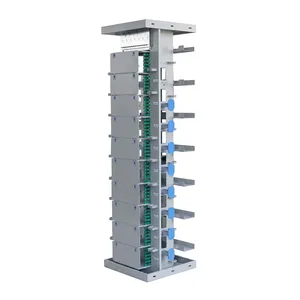
JODF-A1 Optical Distribution Frame
720-port 42U main distribution frame for AI data center meet-me rooms and backbone cross-connects
View Product →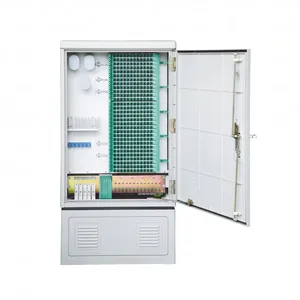
JFDC-288A Fiber Distribution Cabinet
288-port SMC outdoor cabinet for campus-level fiber routing between data center buildings
View Product →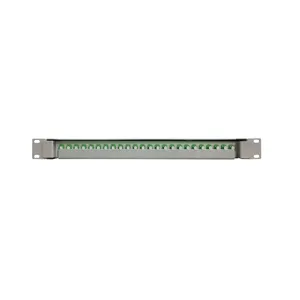
JODF-U3A Optical Patch Panel
24–96 port sliding rack-mount patch panel for 800G/1.6T transceiver connections in AI compute racks
View Product →Related Articles

Why AI Data Centers Need High-Density Fiber Management
How GPU cluster architectures drive 4-8x more fiber ports per rack and what passive infrastructure is required
Read Article →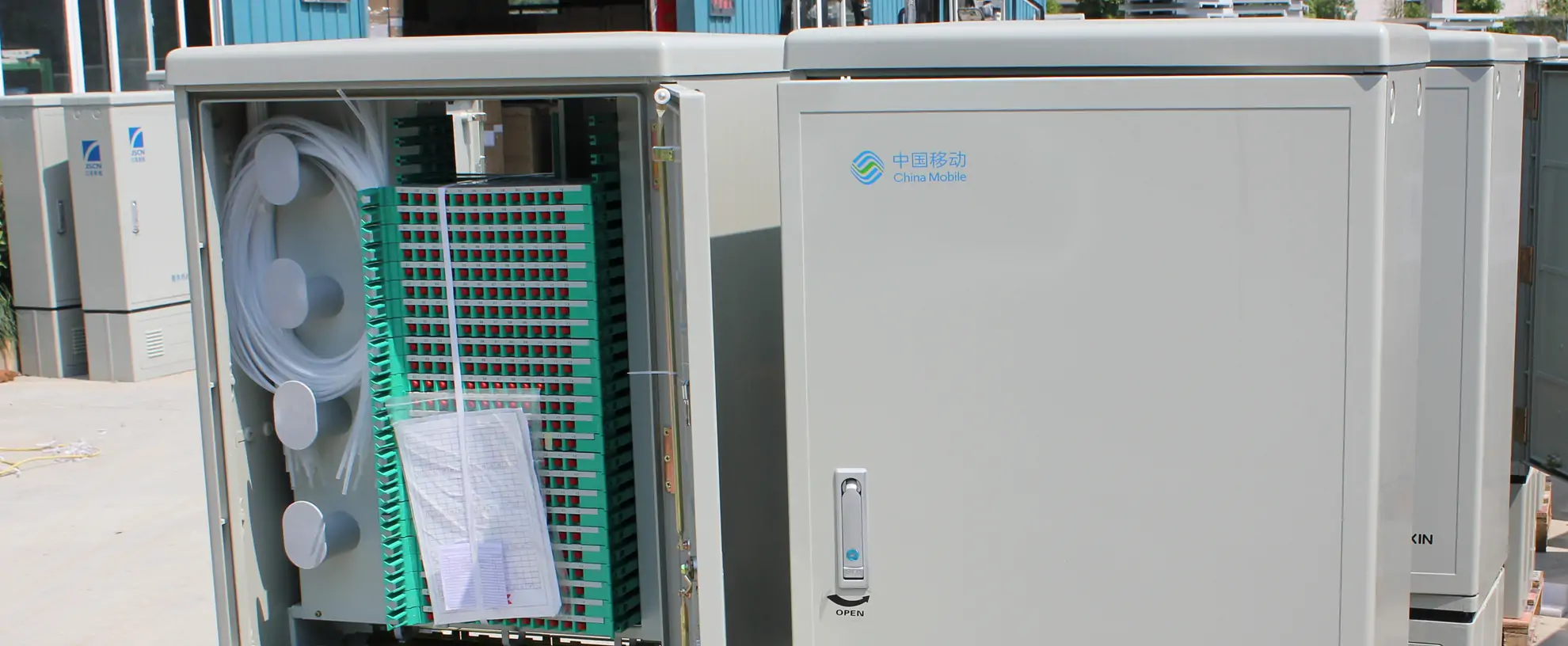
FDC vs FDH vs ODC: What's the Difference?
Regional naming conventions for fiber distribution enclosures and how to select the right type
Read Article →
Fiber Distribution Cabinet Guide: How to Choose
Port planning, material selection (SMC vs steel vs ABS), IP ratings, and deployment considerations
Read Article →